The line stretched down Cermak like a patient serpent, fifty people at least, a chain of bodies pressed close but never close enough to share real warmth. Grady stamped his feet against the pavement for the hundredth time just to remind himself that his toes still existed.
The sound was sharp against concrete and rang like iron in the negative twelve degrees. Negative twelve degrees. Like the inside of a freezer rather the air Chicago’s citizens were expected to breathe. His breath emerged in clouds so thick they seemed solid, crystallizing immediately into microscopic ice that hung suspended in the air for a heartbeat before dispersing. Absolutely insane.
He pulled his scarf higher, covering his nose, but the cold found ways in. It slid through the gap between his collar and neck. It crept up his sleeves where his jacket rode up when he moved. It penetrated the socks inside his boots, making his toes ache with that particular pain that feels almost like burning. But they’d been planning this for almost two weeks, ever since Pulse announced their Winter Solstice Session line up, DJs from Chicago, Berlin, BA, and Detroit, the kind of lineup that happened a few times a year.
The woman ahead of him wore a dress, legs mostly exposed except where they disappeared into ankle boots. Her coat hung open despite the cold, revealing the plunging neckline, the deliberate exposure. She shivered but didn’t close the coat, her breath caught the sodium vapor streetlights and glittered like airborne diamonds. Grady understood. The line was part of the ritual. Suffering was currency. Patience, an offering.
His nose had gone numb five minutes ago, that strange absence of sensation that meant the cold had moved past discomfort into something more dangerous. When he breathed in, the air stabbed his nostrils, his sinuses, traveled down his throat like a blade made of ice. Each inhale felt sharp enough to cut. Each exhale emerged as that thick cloud, that visible proof of life, that he was still generating heat inside his chest despite everything the December night was doing to claim it.
Behind him, Marcus and Jen huddled together, sharing warmth the way couples could. Grady stood alone, hands shoved deep in his pockets, shoulders hunched, making himself as small as possible to conserve what heat remained. Every few seconds, someone in the line would jump, or dance in place, or do those small calisthenics that people perform when standing still becomes unbearable.
The bass from inside the club vibrated through the brick wall, through the sidewalk, up through the soles of his boots. A promise. A reminder of why they waited. Grady could feel it in his sternum, that low frequency pulse that bypassed his ears and spoke directly to his bones.
The line moved forward half a meter. Then stopped.
His throat burned with cold, the soft tissue of his pharynx protesting every breath. He tried breathing through his scarf, but that just made the fabric damp, which made it colder, which made everything worse. So he went back to breathing the naked air, accepting the sting, the ache, the way his lungs felt scraped raw, used.
Twenty meters from the door.
A man further in the line vomited along the curb, too much pregaming, or maybe just the cold shocking his system. The bouncer didn’t even look. This was Chicago in December; it would all be one with the slush by the end of the night. This was normal. The man’s friends pulled him aside, propped him against the wall. The line compressed, filling the gaps like water finding its level.
Fifteen meters.
Grady’s face had become a mask. He could feel it, the stiffness of his cheeks, the way his jaw didn’t quite want to move properly. His ears ached inside his wool hat. The tip of his nose felt like it belonged to someone else. He touched it with his gloved hand and could barely feel the contact from either end.
The woman in the dress ahead of him was doing that thing where she tensed all her muscles and then released them, over and over, trying to generate heat through pure force of will. It wasn’t working. Grady could see the goosebumps on her calves, could see how her hands shook when she reached up to adjust her hair.
Ten meters.
The door opened to let someone out, and for three seconds, Grady felt it, the wave of heat, the wall of sound, the smell of sweat and perfume and alcohol and humanity compressed into spaces together. His body responded instinctively, leaning forward, craving it. Then the door closed and the cold snapped back like a rubber band, somehow worse for having been briefly teased and interrupted.
Five meters.
He could see the bouncer now, massive in his black jacket, clipboard in hand, he seemed to be utterly unaffected by the temperature. The man had been standing there for hours, would stand there for hours more. Grady wondered what kind of cold resistance you built up, doing that job. What kind of relationship you developed with winter.
Three meters.
The bass was clearer now, no longer just a vibration but actual rhythm. Four on the floor, relentless, mechanical, perfect. Grady’s heart began to synchronize with it without his permission, his pulse adjusting to match the BPM bleeding through the walls.
The woman in the dress reached the bouncer. He checked his list. Nodded. She disappeared through the door, and again that three-second portal of heat and sound opened and closed.
One meter.
Grady pulled out his ID with fingers that could barely grip it properly. The bouncer took it, examined it under a small flashlight, comparing the photo to Grady’s face before scanning it. Handed it back. Stepped aside.
The door opened.
The wall of heat hit him like a physical force, so sudden and complete that his body didn’t know how to process it. His skin ignited with a thousand pins and needles as blood rushed back to his extremities. His ears rang. His nose began to run immediately, the frozen mucus liquefying in seconds. He stumbled forward into the vestibule, and the door closed behind him, sealing him inside.
The sound was immense. Not loud, though it was loud, but immense. The bass vibrated through the floor, through the walls, through his entire skeleton. The high hats cut through the air like razors. The synth line spiraled upward, hypnotic, demanding attention.
He stripped off his coat in the coat check, moving clumsily because his fingers still didn’t quite work right. The attendant took it, handed him a numbered ticket. He removed his scarf, his hat, his gloves. Stood there in just his shirt and jeans and felt the club’s heat begin its work.
The staircase down to the main floor was narrow, dark, pulsing with red light that synchronized with the kick drum. Each step down was a descent into increasing temperature, increasing volume, increasing pressure. The air grew thick with humidity, all those bodies, all that sweat evaporating and condensing and evaporating again.
At the bottom of the stairs, the space opened up.
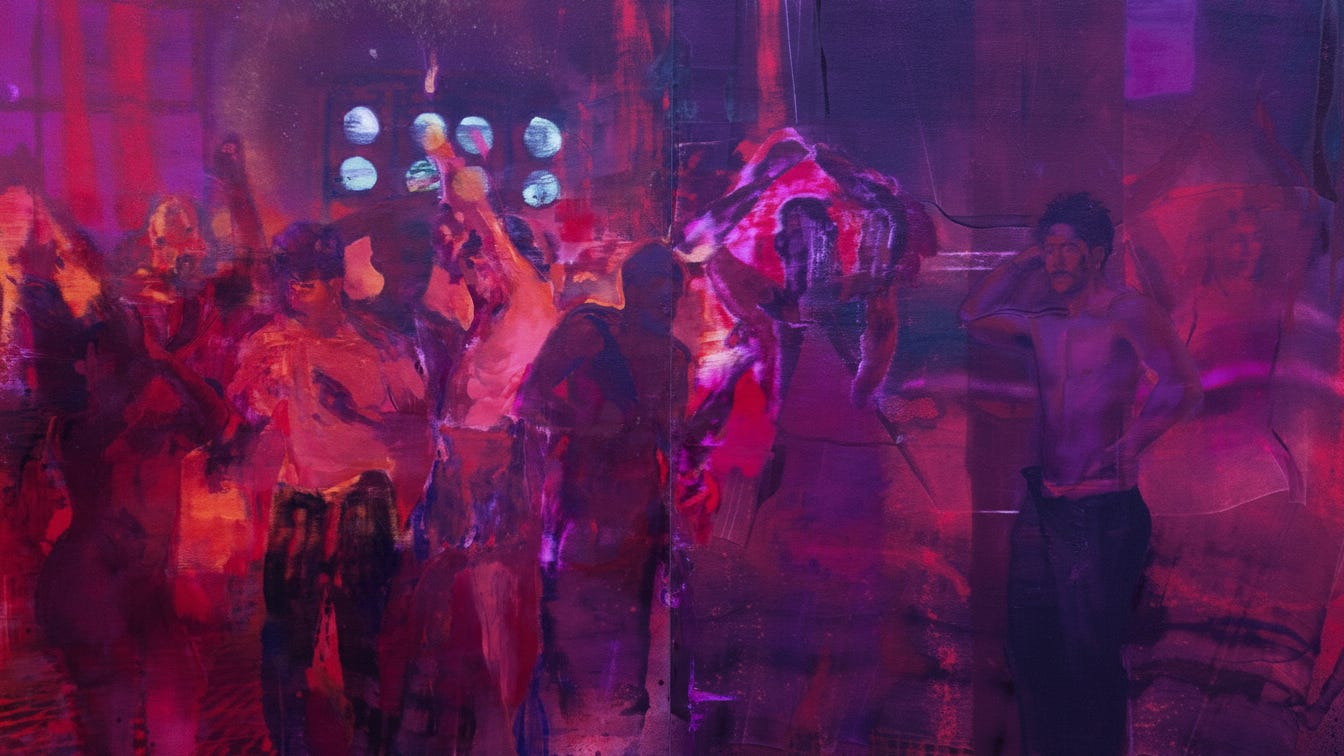
The dance floor stretched out in darkness punctuated by strobing lights that turned movement into freeze-frames, into stop-motion animation. Bodies moved in the space like a single organism, connected by rhythm, by heat, by the simple fact of being together in this specific moment.
Grady pushed into the crowd.
The heat was overwhelming after the cold. Within thirty seconds, he could feel sweat forming at his temples, at the small of his back. The air was thick enough to taste, salt and alcohol and that particular musk of a hundred people dancing in proximity. He found a space, not much space, just enough to move, to move and let the music take him.
The techno was pure and mathematical. Vocalization, melody, rhythm and texture, and that relentless forward momentum. The kick drum hit at maybe 128 BPM, each beat a small explosion in his chest. The bass rolled underneath, subterranean, felt more than heard. Above it, synthesizers traced geometric patterns in sound, angular and precise. Grady closed his eyes and moved.
His body was still adjusting to the temperature change. He could feel it, the way his blood vessels dilated, the way his heart rate accelerated, the way his skin flushed hot and then hotter. Sweat broke out across his forehead, his neck, under his arms. His shirt began to stick to his back. Around him, bodies pressed close in the crowd’s compression and release. A shoulder brushed his. A hip bumped against him as someone spun. An elbow grazed his ribs. A finger brushed the back of his neck. The proximity not quite intimate but not anonymous either. Something in between. Something made permissible by the heat and the darkness and the music’s insistence.
The contrast was erotic in a way Grady hadn’t anticipated. Thirty minutes ago, he’d been freezing, alone, numb to sensation. Now he was hot, surrounded, hyperaware of every point of contact. The woman in the dress from the line was somewhere nearby, he caught glimpses of her bare shoulders, slick with sweat, reflecting the strobing lights. A man with his shirt off danced with eyes closed, arms raised, his torso glistening.
The music built. The synth line ascended, note by note, the tension increasing. The crowd felt it, responded to it, the movement becoming more intense, more urgent. Bodies pressed closer. Someone’s hand touched Grady’s shoulder, steadying themselves or reaching out or just moved by the music’s demands, he couldn’t tell and it didn’t matter.
The drop hit.
The bass exploded, the kick drum doubled, and the crowd surged like a wave. Grady found himself pressed against strangers, felt the heat of their bodies through his thin shirt, felt the moisture of their sweat mixing with his own. An arm around his shoulders, Marcus, finding him in the crowd, grinning wild and unguarded. Jen somewhere nearby, dancing with her eyes closed, lost in it.
The freedom was absolute. No one was watching. Everyone was watching. It didn’t matter. The heat erased self-consciousness. The rhythm erased thought. The proximity erased isolation.
Grady’s shirt was soaked now, clinging to him like a second skin. His hair was wet. Sweat ran down his temples, his neck, the center of his back. When he moved his arms, he could smell himself—salt, musk, his cologne, and the particular scent of physical exertion. He could smell everyone around him too, a hundred different chemistries mixing in the superheated air.
A woman danced facing him, not quite with him but not quite separate either. Their movements synchronized for a moment, matched the rhythm, and in that synchronization was something electric. Her tank top was dark with sweat. Her arms glistened. When she raised them above her head, he could see the curve of her ribs, the slight hollow below her sternum, the way her body moved with breath and rhythm.
She smiled. He smiled back. Then the crowd shifted, and she was gone, absorbed back into the mass of moving bodies. He felt a hand, strong and firm run down his spine and he closed his eyes, the contact the sensation of the pressure matching the music. Then the crowd shifted.
The DJ mixed into something darker, the bass dropping lower, the rhythm becoming more insistent. The lights cut out completely for five seconds, pure darkness except for the green of the exit signs, and in that darkness, Grady could feel the crowd’s collective breath, the way everyone moved together even without visual reference, guided only by sound.
When the lights returned, they were purple, strobing at half the tempo of the kick drum, creating a strange slow-motion effect. Bodies moved through the purple light like swimmers through deep waters of the Great Lakes.
Grady had lost track of time. Could have been twenty minutes. Could have been two hours. In the club’s heat and darkness and rhythm, time worked differently. Measured only in tracks, in builds and drops, in the slow accumulation of exhaustion that felt more like transcendence. His legs ached. His feet hurt in his boots. His shoulders burned from holding his arms up. But these sensations were distant, processed through the filter of the music’s overwhelming presence. The pain was just information. The exhaustion was just a state. Neither could touch the core of what he was feeling, this pure, uncomplicated freedom.
Another build. The synth climbing again, searching for some impossible height. The crowd responding, arms raising, voices shouting wordlessly, everyone understanding that something significant was approaching. And then it hit, not a drop but a breakdown. Everything cutting out except the kick drum, bare and exposed and perfect. Just that single pulse, hitting four times per measure, and the crowd moving to nothing else, needing nothing else.
In that stripped down moment, Grady understood something about contrast. About cold and heat. About isolation and proximity. About the way the body craved both extremes and found meaning in the movement between them. The line outside had been necessary. The cold had been necessary. You couldn’t appreciate this heat, this press of bodies, this freedom, without first experiencing its opposite.
Someone pressed against his back, not aggressive, just moved by the crowd’s compression. He felt their breath on his neck, hot and rapid. Felt the moisture of their sweat through both shirts. The intimacy was shocking and completely casual. He wasn’t sure if he felt their tongue on his neck. This was what the club allowed. This was what the heat and darkness made permissible. The kick drum continued, metronomic, eternal. Grady danced to it, with it, inside it. His body had become purely responsive, all conscious thought burned away by the heat and the rhythm and the sheer sustained intensity of sensation.
Marcus appeared again, handed him a bottle of water that was somehow still cold. Grady drank half of it in one long pull, felt it trace a cool path down his throat, into his overheated center. The contrast again. Always the contrast.
The DJ mixed in a new track, something faster, something brighter. The crowd shifted in response, the movement becoming quicker, more frenetic. Grady moved with it, his body finding new patterns, new rhythms within the larger rhythm. More sweat. More heat. More bodies pressing close in the darkness. A hand on his hip, steadying or dancing or both. A shoulder against his shoulder. Faces passing through the strobing lights, everyone beautiful in their exhaustion, their commitment, their surrender to the music’s demands.
The woman in the dress passed nearby, her makeup long since melted away, her hair plastered to her head with sweat, and she looked transcendent. Looked the way everyone looked at three AM in a club when pretense had been burned away and only essence remained.
Grady raised his arms, closed his eyes, and let the music move through him. Let the heat saturate him. Let the proximity of strangers feel like community, like belonging, like the opposite of that long cold wait in the line outside.
This was why they came. Not for the music alone, though the music was perfect. Not for the dancing alone, though the dancing was necessary. But for this, this transformation from cold to heat, from isolation to connection, from rigid self-consciousness to liquid freedom.
The bass pulsed. The crowd moved. Grady’s body moved with it, through the heat and sweat and darkness, through the endless present moment of the dance floor, through the freedom that could only be found at the far end of endurance, at the bottom of the stairs, in the center of the crowd, in the heart of the heat.
Outside, the December wind howled through Chicago streets at negative twelve degrees. Inside, bodies moved like prayers, like offerings, like pure uncomplicated joy made visible through motion. The music continued. Would continue for hours more. And Grady danced, soaked with sweat, surrounded by strangers, more alive than he’d been in the cold, more present than he’d been standing still.
This was the threshold he’d crossed. This was the transformation he’d paid for with patience and cold.
This was worth every fucking frozen breath.


