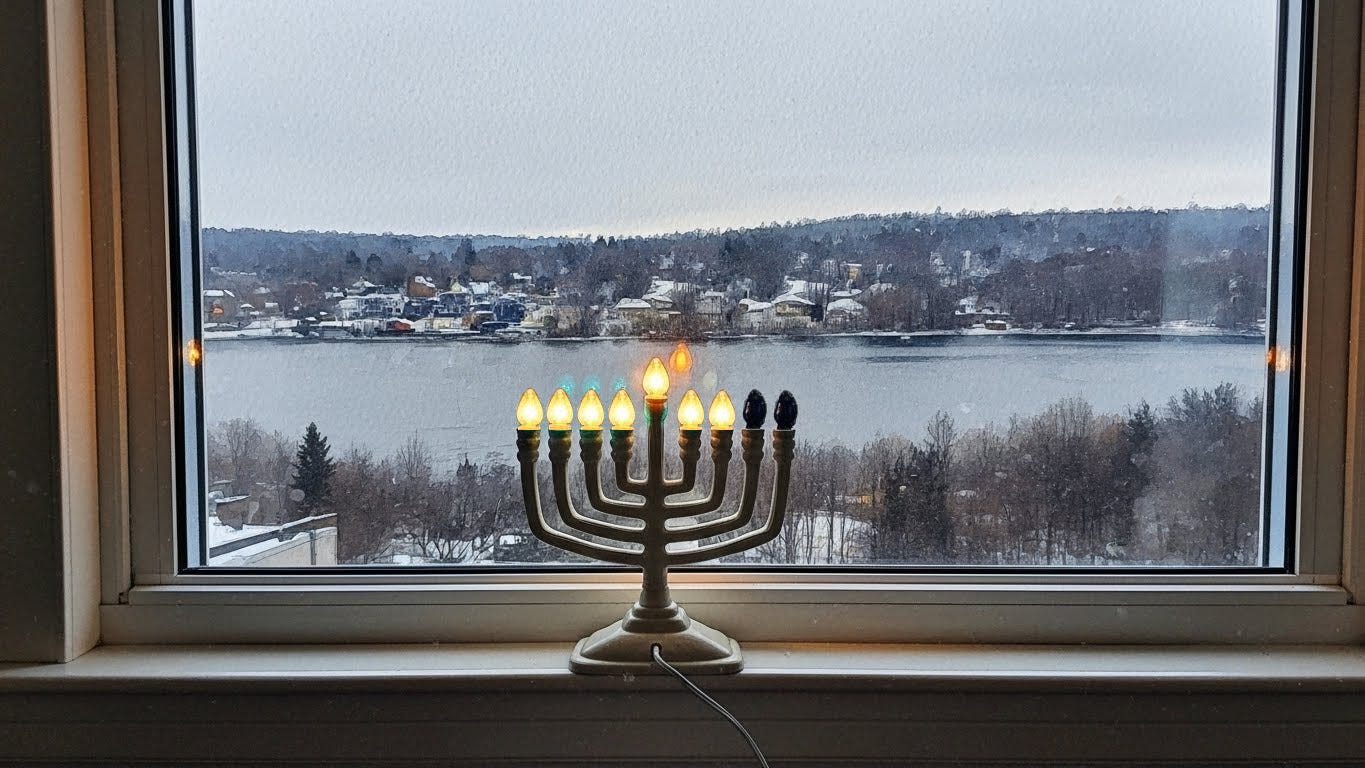
Alastor’s fingers found the switch on the electric menorah, and the sixth light flickered to life, joining the shamash and the five previous nights already glowing on his windowsill.
Outside, the December darkness had settled over the small town of Makochi, which had once been two towns, Malta and McConnelsville, with a population of just over six thousand. Beyond the little town sitting on either side of the Muskingum River, were another 27,292 people within a thirty kilometer distance and the Republic’s healthcare policy was clear; no one should be more than thirty kilometers from comprehensive medical care.
Hence Polyclinic J4RX. Or as everyone here seemed to call it, “The J4.”
Alastor’s room was small but thoughtfully designed, compact, efficient, and comfortable enough for long-term living. A bed built into the wall with storage beneath. A desk and a wall of builtins were opposite his bed. A window that looked out to the river and over Main Street, such as it was. The walls were thick enough that he could barely hear the comings and goings of the other staff members in their rooms along the corridor.
He’d been here five days. Monday through Friday. Long enough to start to learn the rhythm of the place, to memorize which cupboard held which supplies, to understand that Dr. Chen liked her coffee with honey instead of sugar and that Dr. Okoye had a dry sense of humor that had initially made Alastor think he’d done something wrong. Long enough to feel competent. Not long enough to feel at home.
The menorah lights reflected in the window, six small flames that weren’t actually flames at all but LED bulbs, because the dormitory regulations were strict about open flames. His mother probably would have made a face at the electric menorah, would have insisted on real candles, real fire, real tradition. But his mother was in Cincinnati, four hours away by train, celebrating with his dad, who wouldn’t have minded an electric menorah at all, his siblings and his grandmother who made the best latkes in the entire Great Lakes Democratic Republic, or so she claimed with the unshakable confidence of grandmothers everywhere.
Alastor knew after graduating from nursing school he would be assigned a posting. That was the case for everyone, even if it didn’t make the loneliness easier. Two years in a small rural polyclinic would give him experience he couldn’t get in the city hospitals, would teach him flexibility and self-reliance, and allow him to help his people have access to comprehensive care. Two years was nothing. Twenty-four months. One hundred and four weeks. It would pass quickly.
He turned away from the menorah and was reaching for the book he’d been reading when someone knocked on his door.
Not the polite tap of someone passing by. A real knock. Deliberate. Expectant.
Alastor opened the door to find Yuki standing there, one of the other nurses, her expression carefully neutral in a way that immediately made him suspicious.
“Staff meeting,” she said. “Common room. Right now.”
“But it’s Friday night. I thought—”
“Right now,” Yuki repeated, and there was something in her eyes—was it amusement? anticipation?—that made him follow without further questions.
The common room was on the opposite side of the floor past the bathrooms and laundry room, a shared space where the eleven staff members could gather when not working. Alastor had been in it exactly twice, once to watch something on Monday, and once on Wednesday when he’d needed to use the printer. As he followed behind Yuki, he ran through a mental checklist of things he might have done wrong. Had he misfiled something? Miscalculated a dosage? Offended someone without realizing?
Yuki pushed open the common room door, and Alastor’s anxious spiral stopped abruptly.
The entire staff was there. All ten of them, arranged around the large communal table that dominated the room. Dr. Chen, Dr. Okoye, and Dr. Peters, the three physicians assigned to the clinic. Maya, Jorge, Yuki, Kamila, Patrick, and himself, the six nurses, minus Yuki who was behind him. Dr. Rashid, the dentist, and Marcus, the medical technician who ran the lab and handled the diagnostic equipment.
The table was covered with food.
Alastor smelled it before his brain fully processed what he was seeing: the unmistakable scent of matzo ball soup, rich and golden and savory. And latkes—potato latkes, a whole platter of them, still steaming, their edges crispy and brown.
“Surprise,” said Dr. Chen, and she was smiling in a way Alastor had never seen her smile during work hours. “Happy Hanukkah, Good Shabbos.”
Alastor stood frozen in the doorway, his hand still on the frame, trying to understand what was happening.
“We know you’re away from your family,” Dr. Peters said gently. She was the oldest of the three doctors, maybe in her late fifties, with kind eyes and the steady presence that made patients instinctively trust her. “We thought you might like to celebrate here. With us.”
“I.” Alastor’s voice caught. He cleared his throat. “I didn’t think anyone really knew. I mean, I guess I mentioned it to Dr. Chen during my intake interview, but I didn’t think…”
“We pay attention to our people,” Dr. Okoye said. His voice was gruff, but there was warmth underneath. “Even the new ones. Hell, especially the new ones.”
Maya, who was maybe a year older than Alastor and had been friendly in a casual way all week, gestured to an empty chair. “Come on. Sit. The latkes are best when they’re hot, and Marcus threatened bodily harm if anyone started without you.”
Marcus, a tall man with an easy laugh, raised his hands in mock defense. “I just said it would be rude. I didn’t specify the nature of the consequences.”
Alastor moved toward the table mechanically, his mind still trying to catch up. Someone, Jorge, he thought, pulled out the chair for him. Yuki slid into the seat on his left. Dr. Chen was already ladling soup into bowls, the matzo balls floating like small planets in the golden broth.
“We should say a blessing,” Dr. Rashid said suddenly. She looked at Alastor. “Would you like to? Or we could pull a recording up on a Shoyfer if you prefer?”
“I.” Alastor swallowed hard. “I can. That’s okay.”
He hadn’t expected this. Any of this. His mother had sent him off vaguely saying to remember who he was, he’d nodded and promised because that’s how mothers get when you’re leaving home.
But here was an entire table of people, Jews and non-Jews, he assumed, though he didn’t actually know everyone’s backgrounds yet, waiting for him to say a blessing.
His voice caught for only a moment or two as he began. “Baruch atah Adonai, Eloheinu melech ha’olam…” A Macaababy’s gotta do what a Maccababy’s gotta do he couldn’t help but thinking to himself..
He made it through the blessing over the candles, then the eating began.
The matzo ball soup was great, maybe not as great as his grandmother’s, nothing could be, but close enough to make his chest ache with homesickness and gratitude in equal measure. The matzo balls were light and fluffy, the broth was rich with chicken and vegetables, and someone had added fresh dill that released its fragrance with every spoonful.
“Kamila made the soup,” Jorge explained, gesturing toward the quiet nurse who worked primarily in pediatrics.
Kamila ducked her head, pleased but embarrassed. “It’s just soup.”
“It’s great soup,” Alastor said, and meant it.
The latkes were even better, crispy on the outside, tender on the inside, salted exactly right. There was applesauce for topping, and sour cream, and some people were mixing them which Alastor’s grandmother would have found scandalous but this was The J4.
“Marcus made these,” Maya said. “He’s been practicing this week, definitely were some failed attempts.”
“We don’t talk about Tuesday,” Marcus said solemnly. “Tuesday was a dark day for potatoes everywhere.”
Everyone laughed, and Alastor found himself laughing too, the tension that had been living in his shoulders since Monday finally starting to ease.
They ate and talked, and the conversation flowed easily. Dr. Chen told a story about her first posting twenty years ago, to an even smaller polyclinic in the Upper Peninsula where the nearest backup facility was two hours away by snowmobile. Patrick described his family’s winter solstice traditions, which involved an alarming amount of beetroot. Yuki explained how her parents had celebrated both Buddhist and secular holidays, creating their own hybrid traditions that belonged to neither culture completely but to their family specifically.
“That’s what we’re doing here too, I think,” Dr. Peters said thoughtfully. She’d finished her soup and was working on her third latke. “Creating our own traditions. We’re a family here, in our way. Eleven people living and working together. We might as well celebrate together too.”
“The J4 family,” Jorge said, raising his glass in a mock toast.
“God help us all,” Dr. Okoye muttered, but he was smiling.
Alastor looked around the table, at these people he’d known for less than a week, and felt something shift in his chest. He’d been so focused on missing his family in Cincinnati, on the two years stretching ahead like an exile, that he hadn’t considered this possibility, that a different kind of family might be waiting for him here.
“Thank you,” he said suddenly, and his voice came out rougher than intended. “I mean it. I was... I was dreading tonight. Being alone. And this,” He gestured at the table, the food, the people. “This means more than I can really say.”
Dr. Chen reached across the table and patted his hand. “You’re one of us now. That means something here. The J4 takes care of its own.”
“Even when we’re annoying,” Maya added.
“Especially when we’re annoying,” Marcus corrected.
“You’ll learn everyone’s quirks soon enough,” Yuki said from beside him. “Dr. Okoye reorganizes the supply closet every Sunday. Dr. Peters talks to the plants in the waiting room. Jorge sings when he thinks no one can hear him.”
“I do not sing,” Jorge protested.
“You absolutely sing,” said at least three people simultaneously.
The conversation dissolved into friendly arguing about who had which peculiar habits, and Alastor sat back in his chair, his bowl empty, his stomach full, and watched them all. These people who’d taken time out of their Friday evening to make a new staff member feel welcome. Who’d learned what holiday he celebrated and had somehow coordinated to make it special. Who’d cooked and planned and gathered together not because they had to, but because they wanted to.
Dr. Rashid, who’d been quiet for most of the meal, leaned forward. “I should mention, we do this for everyone. It’s not just you, or just Hanukkah. When Yuki first arrived, we celebrated Tanabata. When Jorge came, we did Día de los Muertos. We’re a polyclinic, which means we’re a community. We mark the things that matter to each other.”
“It’s one of the few good things about being assigned somewhere small,” Dr. Peters added. “In the city hospitals, you can disappear into anonymity. Here, we can’t avoid each other even if we wanted to.” She smiled. “So we might as well be family.”
Kamila stood and disappeared into the kitchen off the common room, returning with something on a plate. “I also made these,” she said shyly, setting down a plate of what were unmistakably sufganiyot, jelly donuts, traditional for Hanukkah, dusted with powdered sugar.
Alastor felt his eyes prickle with tears he absolutely was not going to cry in front of his new colleagues on his fifth day of work. He blinked hard, picked up one of the donuts, and took a bite. Raspberry jelly. Perfect.
“These are incredible,” he managed.
“It’s my grandfather’s Pączki recipe modified a little bit,” Kamila said. “He made them every year. Taught me before he passed.”
They ate the sufganiyot, and someone made coffee, someone else brought out Yerba Mate, and the conversation shifted to lighter topics, the upcoming winter festival in town, the rumor that the polyclinic might get upgraded equipment next year, speculation about whether the river would freeze solid enough for ice skating.
Slowly, people began to drift away. Early shifts tomorrow, even on Saturday. The polyclinic ran every day, staffed in rotation. Dr. Okoye was first to leave, collecting his dishes and bidding everyone goodnight with that same gruff warmth. Then Jorge and Patrick, then Dr. Rashid. Eventually it was just Alastor, Dr. Chen, Dr. Peters, and Yuki, the four of them nursing the last of the coffee in comfortable silence.
“You’ll be okay here,” Dr. Peters said finally, looking at Alastor. “I know two years seems like a long time. But you’ll look back on this posting and realize it shaped you in ways you never could have realized.”
“Plus,” Yuki added, “we’re actually pretty fun once you get to know us. Despite all evidence to the contrary.”
Dr. Chen stood, started collecting the remaining dishes. “Go,” she said to Alastor. “We’ll clean up.”
“I can help.”
“You can help tomorrow, and the day after, and the day after, and for the next seven hundred and twenty-five days,” Dr. Chen said firmly. “Tonight, you rest. You’ve had a long first week.”
Alastor wanted to argue, but he was overwhelmed, by the food, by the kindness, by the sudden certainty that he was going to be okay here. That maybe he was even going to be happy. He thanked them again, received hugs from Yuki and Dr. Peters, a nod from Dr. Chen that somehow conveyed as much warmth as any hug, and made his way back to his small room.
The electric menorah was still glowing in the window, its six lights joined now by the reflected lights from the other buildings along Main Street, from the Christmas Tree in the town square, and blow molds in people’s yards. Alastor stood at the window for a long moment, looking out at the small town that he was so certain was going to be his exile, it didn’t feel like exile anymore.
He pulled out his Shoyfer and sent a message to his mom: Had dinner with the staff. Matzo ball soup and latkes. They surprised me for Hanukkah. I think I’m going to be ok here.
Her response came quickly: Of course you are. You’re our son, we’re always okay, even when we think we won’t be. We’re so proud of you.
Alastor smiled at the screen, at the certainty in her words. He set the phone down, changed into a pair of joggers, and climbed into his bed. Through the floor, he could hear the muffled sounds of people moving in the rooms below, the polyclinic settling into its nighttime rhythm, staff members preparing for the next shift, the building itself breathing in and out like a living thing.
Alastor closed his eyes. Two years. Seven hundred and twenty-five days. It still seemed like a long time, but maybe not an impossible time. Not with sufganiyot and matzo ball soup. Not with people who paid attention and cared enough to celebrate. Not with the J4 family, strange and small and located in the middle of nowhere, but family nonetheless.
The sixth night of Hanukkah. Two more to go, and then the holiday would end, and the regular work would continue. But something had changed tonight. Some door had opened that couldn’t be closed again. Alastor fell asleep with the taste of toothpaste and latkes still on his tongue and the warmth of unexpected belonging still glowing in his chest, brighter than any menorah, electric or otherwise.
Outside, snow began to fall, it and the December darkness covered Makochi and the Muskingum River valley, but inside Polyclinic J4RX, the lights stayed on, keeping watch, keeping warm, keeping the small family of healers safe through another snowy winter night.


