


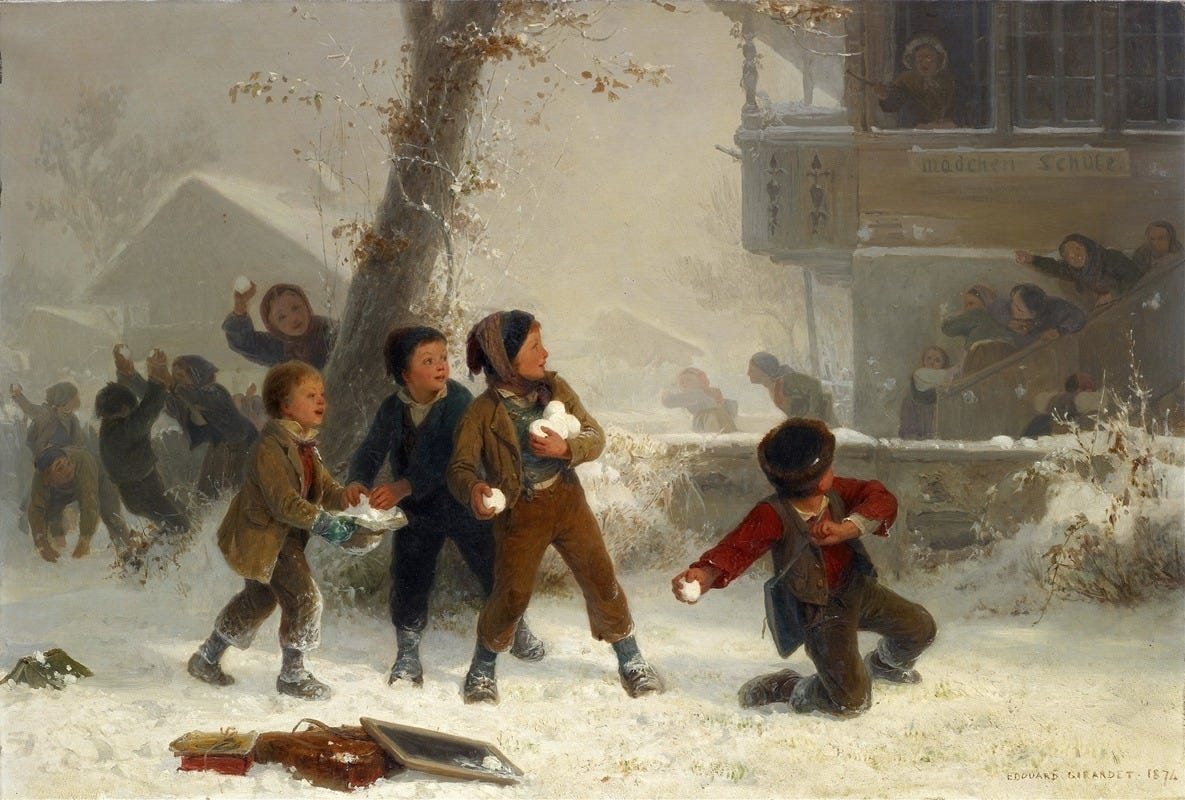
The kitchen smelled of freshly baked poppy seed bread their mother only made during the winter holidays and the five Novak Roberts siblings sat around the same table where they’d eaten countless meals as children. Through the window, snow fell steadily on their parents’ backyard, clinging to the windows, heavy and wet. Perfect snow to make a snowman, or have a snowball fight.
“Remember,” Tomas said suddenly, setting down his coffee, “the snowball fight?”
He didn’t need to specify which one. There had been dozens of snowball fights over the years, but only one that had earned the definite article. The snowball fight.
Kayla laughed, nearly choking on her sufganiyah. “Oh yeah. The Great War of—what year was that? We were still in primary school.”
“You were still in primary, I had gone to the vocational school,” said their oldest brother, Patrick, who at forty-seven was starting to look alarmingly like their father. “So that would make you,” he pointed at Kayla, “in third? Tomas was in fourth, Maria was in first, and I don’t think Anna was even in school yet.”
“Yeah I was five,” Anna confirmed. She was the youngest, now in her early thirties with two kids of her own. “Old enough to remember, young enough to have be absolutely fearless.”
“Old enough to be a menace,” Maria corrected, but she was smiling. Maria was the careful one, the one who’d become an engineer, who measured everything twice. “You were throwing snowballs at everyone indiscriminately. No strategy whatsoever.”
“I had a strategy,” Anna protested. “My strategy was chaos.”
Their mother appeared in the doorway, wiping her hands on her apron. She was smaller than she’d been in their childhood, or perhaps it was that they’d just grown taller. Her hair had gone almost completely silver, pulled back in the same practical bun she’d worn for as long as any of them could remember.
“Are you talking about that disaster?” she asked, but there was warmth in her voice. “When you destroyed the Ryan’s snow fence and most of Mrs. Chen’s decorative shrubs?”
“We rebuilt the snow fence,” Patrick said defensively.
“Two weeks later,” their mother replied. “After Mr. Ryan came over to complain three times.”
“To be fair,” Tomas said, “it started so innocently.”
It had started innocently. At least, that’s what they all claimed later.
The snow had come overnight, one of those miraculous accumulations that transforms the world while you sleep. When they’d woken up, in the same house where they sat now, though in those days their parents’ house had seemed vast instead of comfortably modest, there had been at least thirty centimeters of fresh powder covering everything.
School had been canceled. The radio had crackled with the announcement while they ate breakfast, and the five of them had erupted in cheers that made their father lower his newspaper and smile despite himself.
“Outside,” their mother had said, already anticipating the cabin fever that would set in. “All of you. Fresh air and exercise.”
They’d bundled up in layers upon layers of winter gear. Patrick had worn a coat that had been their father’s, sleeves rolled up. Maria had layered two sweaters under her jacket. Tomas’ boots had been a little too small, pinching at the edges of his toes, but he’d said nothing because complaining meant staying inside.
The backyard had been perfect, untouched, a blank canvas of possibility.
“Fort,” Patrick had announced with the authority of the eldest. “We’re building a fort.”
And they had, working together with the focused intensity that children bring to projects they deem important. They’d rolled snow into enormous balls, nearly half a meter in diameter and stacked them into walls. They’d carved out windows for throwing. They’d even made a flag from one of Kayla’s scarves, tied to a branch.
The fort had been magnificent. It had been impregnable.
It had lasted approximately fifteen minutes.
“You threw the first snowball,” Kayla said now, pointing at Patrick.
“That is a lie and a slander,” Patrick replied calmly. “Tomas threw the first snowball.”
“I threw a snowball at you,” Tomas clarified. “That’s different from throwing the first snowball. You’d already hit Maria.”
“That was an accident!”
“Well, then your ‘accidents’ were remarkably well aimed,” Maria observed.
Their mother shook her head, returning to the kitchen, but they could hear her laughing.
However it had started, and the true origin had been lost to the fog of war and competing narratives, the snowball fight had escalated rapidly.
Patrick and Tomas against Kayla and Maria. Anna switching sides every five minutes or so, loyal only to whichever team was currently winning. The backyard had been too small to contain them, so they’d spilled into the front yard, then into the Ryan’s yard next door, then across Maple Street to where the Chen Zhi’s lived.
The snow had been perfect for packing, wet enough to hold together but not so wet that it turned to slush. They’d made ammunition factories, churning out snowballs with the assembly line efficiency of the US war machine. They’d dug trenches. They’d constructed satellite forts. They’d formed and broken alliances with a speed of wartime diplomacy to make even Europe blush.
Other children had joined, this was before everyone had schedules and structured activities, when a snow day meant genuine freedom. The Ryan twins. Chen’s nephew who was visiting from out of town. The Rodriguez kids from three houses down. At the battle’s peak, there had been maybe twenty children engaged in glorious, chaotic warfare across four adjacent yards.
Anna had been fearless, charging across open ground with snowballs in both hands, screaming battle cries of pure invented sound. Maria had been strategic, directing defensive positions from behind the original fort. Kayla had been fast, darting between cover points, her aim deadly accurate. Tomas had been everywhere at once, switching allegiances, brokering temporary truces, then immediately violating them.
And Patrick had been the general, standing atop the highest wall of the fort, over a meter tall when it was all said and done, which at the time had seemed like commanding a fortress tower, directing operations and making grand pronouncements about honor and victory.
Until he’d lost his footing and crashed through the Ryan’s decorative fence.
“You should have seen your face,” Kayla said now, wiping tears from her eyes. “Just, complete shock. And then Mr. Ryan came out—”
“In his undershirt!” Tomas added. “In the middle of a snowstorm, just wearing an undershirt and his work pants.”
“Yelling at us about respect and property and hooligans.”
“And you were just laying there in the ruins of his fence, covered in snow.”
Patrick was laughing too hard to defend himself. “I thought, I genuinely thought he was going to have me arrested or something.”
“You were eleven,” Maria said.
“Tell that to eleven-year-old me, sitting in the wreckage of his fence.”
Their father appeared in the doorway now, drawn by the laughter. He was more stooped than he’d been, his hands showing signs of arthritis, but his eyes were still sharp.
“The Great War of Maple Street,” he said, settling into his chair at the head of the table. “Your mom made you all go apologize, individually, to every neighbor whose yard you’d destroyed,” he chuckled.
“Character building,” Patrick said solemnly placing a hand over his heart.
“Mortifying,” Kayla corrected.
“Both,” their father agreed. “Mrs. Chen she had you help her replant her shrubs in the spring. Remember?”
Maria nodded. “She taught me the names of all the plants in her garden. To be honest, I think that’s actually why I got interested in engineering, she explained how the roots worked, how the water moved through the plant, the whole system of it.”
“Mr. Ryan made Patrick and Tomas rebuild the fence,” Anna. “’Properly’. With measurements.”
“Best damn fence in the neighborhood,” Tomas said proudly.
They sat in comfortable silence for a moment, passing the plate of sufganiyot, refilling coffee mugs. Outside, the snow continued to fall on their parent’s house just like when they were children, when the world had been different in ways both large and small.
“It’s strange,” Maria said quietly. “Remembering it now. We were just kids having a snowball fight. But it was also, I don’t know. The last gasp of the old world, maybe? Everything changed so fast after that.”
She was right, though none of them had understood it at the time. Those years had been a hinge point, the moment when the old order had begun its final dissolution. Within a few years, the internet would continue to change the world forever, the US would be attacked, changing how the North American nations interacted with each other. The US housing market hadn’t collapsed yet, and Europe still used thirty nine different currencies.
“Do you remember being scared?” Kayla asked. “During the whole Y2K thing?”
Their father considered this. “I remember being a little nervous, yes. But also—hopeful? It was also cool to be entering a new millennium.”
“I remember Mom stockpiling food,” Patrick laugh. “Canned goods in the basement, a bunch of water. Just in case.”
“Just in case of what?” asked Anna.
“In case it all fell apart,” their mother said, returning from the kitchen with fresh coffee. “You should have it, they way they talked about a computer induced apocalypse. In case there was violence. In case we couldn’t go to stores, we needed to feed not just our family but the neighbors too.” She paused. “Obviously, we never needed it. The whole Y2K thing ended up being completely overblown. But I’m a mother. Mothers prepare for the worst while hoping for the best.”
“The snowball fight was before all that,” Tomas said. “Before we understood that the world could change. We were just kids in the snow, playing.”
“You were always playing,” their father said, but fondly. “All of you. Even when things were difficult, even when your mother and I were working, you played. You found joy in small things. Snowball fights. Building forts. Making chaos in the neighbors’ yards.”
Anna’s phone chimed, a message from her husband, asking when she’d be home. Asking if he should give the kids their baths if she wanted to stay our longer. Baths, bedtime stories, the ordinary architecture of family life.
“I should probably head out soon,” she said reluctantly.
But she didn’t move, none of them moved. Not yet.
“You know what I think about sometimes?” Patrick said. “That snowball fight wasn’t just chaos. It was also cooperation? Like, we built that fort together. And yes, we fought against each other, but we also worked together. Even when we were on different teams, we were all part of the same game.”
“Very philosophical for someone who fell through a fence,” Kayla teased.
“I’m saying,” Patrick continued, ignoring her, “maybe that was its own kind of lesson. About how community works. You can be in conflict and still be connected. You can compete and still cooperate. You can destroy someone’s decorative shrubs and then spend the spring replanting them together.”
Maria laughed. “Are you really arguing that our childhood snowball fight was a metaphor for collective governance?”
“I’m arguing,” Patrick said, grinning, “that everything is a metaphor if you’re pretentious enough.”
Their mother swatted him gently with a dish towel while the table shared a laugh.
They did leave, eventually. Patrick to his apartment in the city center, where he taught history at the university. Maria to the home she shared with her wife and their children. Kayla to her shift at the Polyclinic, she was a nurse, working the overnight rotation this week. Tomas to the train station. By day he coordinated the freight routes that connected the Republic.
Anna lived the closest, just three kilometers away in one of the new housing cooperatives. They hugged their parents goodbye, promised to return in a few days for the solstice dinner, stepped out into the snow that was still falling, had been falling all day, might fall all night.
Walking to the tram stop, Patrick found himself looking at the houses along Maple Street. Many were the same as he remembered, though some had been renovated, or converted into cooperative housing. The Ryan’s house was still there but the fence was gone, replaced with greenery, the Chens’ house had been painted a cheerful blue.
But Patrick could still see it in his mind, that moment of pure shock when the fence had given way beneath him, when he’d tumbled into the snow, when he’d looked up to see Mr. Ryan’s furious face and his siblings’ expressions of combined horror and delight. He could still feel what it had been like to be eleven years old, to believe that destroying a fence was the worst thing that could happen, to live in a world small enough that a single street contained all the adventure and conflict and resolution a person could need.
The tram arrived, and Patrick climbed aboard, tapping his transit card. The same card he’d use tomorrow to ride across the city, past buildings and cooperatives and collective enterprises that had been impossible to imagine back then. But some things remained. The snow still fell the same way. Siblings still teased each other at kitchen tables. Mothers still fed their children and worried. Fathers still told old stories with new understanding. And somewhere, probably, children were having snowball fights, making chaos, building forts that would last fifteen minutes, creating memories that would last forty years.
The tram carried Patrick through the snowy evening, through the city that he loved, through the Republic that he loved, through his home. Outside, the snow continued to fall, covering everything in white, making the world new again, the way it had on that morning all those years ago when five siblings had woken to find thirty centimeters of possibility waiting outside their door.
The way it would continue to fall, winter after winter, on children who would grow into adults, on adults who would remember being children, on a world that had changed and would change again, but would always, somehow, still have room for snowball fights and laughter and the simple grace of siblings gathered around their parents’ dinner table, passing plates of pastries, telling old stories, and building new memories from the raw material of the past.