The high speed train pulled out of the station with the smooth acceleration that still amazed Joel, even after years of riding the Republic’s rail network. Through the window, Chicago’s skyline stood sharp against the early January sky, the kind of crisp clarity that only came with single digit temperatures and clean winter air.
Snow had started falling again, the fine granular kind that didn’t really accumulate but made everything look softer, quieter. Joel found his seat in the second car, settled in by the window, and watched Chicago slide away as the train accelerated south.
The countryside between Chicago and Normal was flat and white, punctuated by bare trees and the occasional farmhouse, smoke rising from chimneys in straight lines until the wind caught it. Wind mills spinning in the cold January wind. The train moved fast, two hundred and forty kilometers per hour on this stretch, but smoothly enough that Joel could drink his Yerba Mate without spilling.
He’d made this trip a dozen times over the years. He and Imogen had been friends since university. They’d stayed close through moves and career changes and the general chaos of building adult lives. Now Joel worked for the Regional Health Center in Chicago, and Imogen managed a community textile collective in Normal. They saw each other as often as their busy lives would allow.
This visit was different, though.
Imogen’s father had recently passed, suddenly, the kind of loss that arrives without warning and leaves everyone scrambling to understand a world that’s been fundamentally rearranged. This was an important visit. The one where he showed up because she was his best friend and she was hurting and sometimes the only thing you could do was be present.
The train slowed as it approached Normal. Joel shouldered his bag, finished the last of his Maté, and joined the small crowd at the doors. The station was modest, two platforms, and a waiting area with indoor connections to local and regional buses, a large mural on one wall showing the agricultural history of of the area rendered in bold, optimistic colors.
Imogen was waiting just inside the entrance, bundled in a heavy coat and a ridiculous fuzzy hat with ear flaps that Joel had given her as a joke three years ago. She’d actually kept it. She actually wore it.
“You look like a very serious person in that hat,” Joel said by way of greeting.
“You look like someone who just spent ninety minutes on a train,” Imogen replied, but she was smiling as she pulled him into a hug.
She looked tired, Joel thought. The kind of tired that sleep doesn’t fix. But she also looked like herself, same sharp eyes, same slightly crooked smile, same Imogen who’d been his friend for seventeen years.
“Bus to the brewery?” she asked as they stepped outside into the snow.
“Is that even a question?”
The community owned brewery officially called McLean Brewing Collective but everyone just called it “the Collective”, was about three kilometers from the station. They caught the Number 4 bus, which was warm and half empty, and rode through downtown Normal while Imogen pointed out changes since Joel’s last visit: a new community center, a renovated park, a mural that the local arts collective had painted on the side of the Posti building.
“We’re becoming gentrified by our own cooperatives,” Imogen said. “Very on brand for the Republic.”
The Collective occupied a warehouse like structure on the edge of town. Inside, it was all exposed brick, reclaimed wood, barrels, and the rich yeasty smell of beer being brewed in the enormous steel tanks visible behind glass walls. The space was about exceptionally full for a Monday evening, people coming from work, a few families with kids playing board games at the large communal tables, a group of university students arguing passionately about something in the corner.
Joel and Imogen claimed a small table near the windows, ordered food from the menu that changed based on what the local agricultural cooperatives had available, and settled in.
Above the bar, a television showed a hockey game, the Titans playing the Aces, the game provided pleasant background motion and noise, the familiar rhythm of bodies moving across ice, and accounted for the larger than usual crowd.
“How were the Yuletimes?” Joel asked after their beers arrived, a red ale for him, a stout for her.
Imogen took a long drink before answering. “Strange. We still did everything we usually do, the solstice dinner, the gift exchange, all of it. But there was just this air about it, ya know?” She turned her glass in her hand.
Joel reached across the table, squeezed her free hand briefly. “I’m sorry.”
“Yeah.” Imogen nodded. “Me too.” She was quiet for a moment, watching the hockey game without really seeing it. “But I’m managing. That’s what people do, right? They manage. They keep going because stopping isn’t really an option.”
Joel nodded.
Imogen paused, searching for the right word. “I’m processing. I was looking into one of those grief groups they have over at the community center. Thank you for coming. This means a lot.”
“Of course.” As if there had been any question.
Their food arrived—a salmon and brussel sprout salad for Joel, a tandoori grain bowl for Imogen, both served with the efficiency that characterized the Collective’s approach to hospitality. They ate and talked, and gradually the conversation shifted from grief to other things. Imogen told him about a project she was working on, converting old textiles to be reused to make school jackets. Joel described his current nightmare of a dispute involving three different units and who would be next to receive the new medcarts.
“The problem with democratic planning,” Joel said around a mouthful of salmon, “is that everyone has opinions.”
“The problem with planning in general,” Imogen corrected with a wry laugh, “is that everyone has opinions and most of them are wrong.”
“Including ours?”
“Especially ours.”
They stayed at the Collective for three hours, working their way through two beers each, the responsible limit before switching to a winter ginger spritz water, and watching the hockey game reach its conclusion in overtime. The Titans won, which pleased the people who had come for the game and community, and beer specials.
Outside, the temperature had dropped further, and the snow was falling more heavily. They caught the bus back toward Imogen’s house, riding through streets transformed into soft white landscapes, the buildings of Normal looking almost magical in the winter evening.
Imogen lived in one of the cooperative housing developments that her husband helped plan. The house was comfortable and decorated in Imogen’s style, full of books and artworks, plants and curated antiques, the kind of organized clutter that comes from actually living in a space rather than just occupying it.
Joel took the guest room, which had clearly been prepared for him, fresh sheets, towels stacked on the dresser, a small vase of winter branches on the nightstand.
He slept well, lulled by the quiet of a smaller city, the snow falling steadily outside.
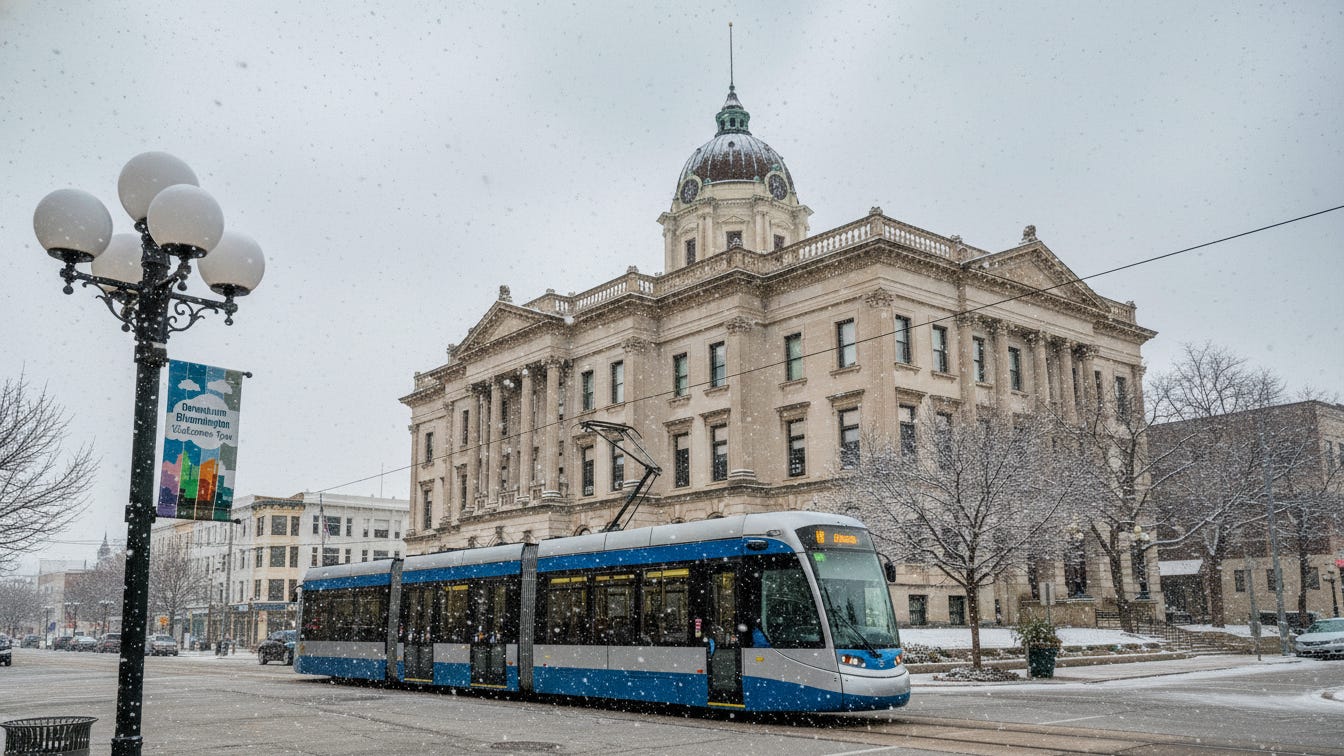
The next morning, they took the streetcar through the historic part of town. It was part transportation, part tourist attraction, part rolling museum. Joel and Imogen boarded at the station nearest to Imogen’s, finding seats near the back. The streetcar was about a third full, people running errands, a few obvious tourists with cameras, a group of school children on some kind of field trip.
The car rattled and swayed as it moved through downtown Bloomington, past the distinctive architecture of the old commercial district, brick buildings from the late 1800s, some renovated into cooperative stores and restaurants, others still waiting for new purposes.
“First stop: books,” Imogen announced as they disembarked.
The bookstore, called “Common Ground Books” occupied a corner building with tall windows and creaking wooden floors. It was the kind of bookstore that the Republic prioritized, a community space over pure economic efficiency, the kind where people could browse for hours without feeling pressured to buy.
Joel and Imogen wandered the aisles separately, occasionally holding up books to show each other. Joel found a history of the Great Lakes region before independence. Imogen discovered a poetry collection by someone from Detroit. They met at the register, purchased their finds, and stepped back out into the cold.
“Spices next,” Imogen said, leading him two blocks down to a narrow storefront that proclaimed itself “The People’s Spices.”
Inside, the air was thick with competing fragrances—cinnamon and cardamom, cumin and coriander, things Joel couldn’t identify but that made his nose tingle pleasantly. The proprietor, a man in his fifties with kind eyes and impressive forearms from grinding spices, greeted Imogen by name.
“This is Joel,” Imogen introduced. “He’s visiting from Chicago.”
“Chicago!” the man said with the enthusiasm of someone who had opinions about cities. “The big city. We’re too quiet for you here, I bet.”
“Quiet is good sometimes,” Joel replied diplomatically.
They browsed the jars and bags of spices, Imogen selecting things with the focused intensity she brought to all decisions. Smoked paprika. Sumac. Something called “winter blend” that was apparently good on roasted vegetables.
“How were your holidays?” Imogen asked as they walked toward the next destination.
“Chaotic,” Joel admitted. “We hosted, which meant my mother spent the entire time giving unsolicited advice about cooking, my brother in law tried to explain US cryptocurrency to my father, who couldn’t have cared less, and my nieces performed an interpretive dance about winter solstice that lasted a painful thirty-five minutes.”
“That sounds nice though.”
“It was exhausting.” Joel paused. “But yeah, also kind of perfect.”
Their next stop, the pagan store called “Sacred Circle” was tucked into a small building with deep purple accents on the outside. Inside, it was moodily lit and filled with an eclectic mix of items like, crystals and tarot decks, books on herbalism and ritual, statues of various deities, bundles of sage and sweetgrass, candles in every imaginable color.
“I like the energy of places like this. People come here looking for meaning, for connection, for something bigger than themselves. That feels important right now.”
She bought a small bundle of cedar and a candle that was supposed to promote healing. Joel picked up a deck of holographic tarot cards. There was something comforting about a space dedicated to hope, the abstract, and unapologetically itself.
By the time they emerged back onto the street, it was past noon and they were both hungry. The ramen restaurant, “Slurp Slurp Noodle” was two blocks away, warm and steamy and already filling up with the lunch crowd.
They ordered at the counter, tonkotsu for Joel, miso for Imogen, and found a small table by the window. Outside, the snow continued to fall, lighter now, almost decorative.
“I’m glad you came,” Imogen said once their ramen arrived, the bowls enormous and fragrant. “I know it’s not the most exciting trip. Just walking around, buying spices, eating noodles.”
“This is exactly what I wanted to do,” Joel said, and meant it. “Just be here. With you. Doing normal things.”
“Normal things in Normal,” Imogen said, smiling at her own pun.
They ate their ramen in comfortable silence for a few minutes, the kind of silence that only exists between people who’ve known each other long enough that not talking isn’t awkward.
“I’ve been thinking about the future,” Imogen said eventually. “Not in a big philosophical way, just practically. What comes next. What I want to do with my work, with my life.”
They finished their ramen, paid at the counter, and stepped back out into the January afternoon. The streetcar took them back toward Imogen’s neighborhood, rocking gently on its tracks, the heater working overtime against the cold seeping in through the windows.
“How long are you staying?” Imogen asked as they walked from the streetcar stop to her building.
“I’ve got to catch the train at 1300 tomorrow,” Joel said. “Work on Friday.”
“We should do breakfast before you go. There’s a place near the station that does excellent pancakes.”
“Sold.”
They spent the rest of the afternoon at Imogen’s house, drinking coffee and reading their new books and occasionally commenting on things that didn’t require response. It was the kind of companionable time that was easy to take for granted but was actually rare and valuable, just being in the same space, existing together without performance or pressure.
For dinner, Imogen made pasta with the spices they’d bought, and they ate at her kitchen table while discussing a documentary they’d both seen about the renewable energy grid.
Later, lying in the guest room with snow tapping against the window, Joel thought about friendship and proximity and the way life kept moving forward even when you wanted it to pause. He thought about Imogen navigating her grief while still showing up for work, still showing up for her family, still making plans for the future. He thought about how the best thing he could do for his friend was exactly what he’d done, show up, eat ramen, buy spices, talk shit, and be present.
Tomorrow he’d take the train back to Chicago, back to his own life and work and responsibilities. But tonight he was here, in Normal, in early January, while snow fell steadily on the quiet streets, being the kind of friend who visited not because there was anything exciting to do, but because being together was exciting.
The next morning, they had pancakes.
The place near the station was called “The Griddle”—simple, direct, and with enormous pancakes that came with real maple syrup from the northern cooperatives. Joel ordered coffee, Imogen matcha, and they sat in a booth by the window watching the town wake up slowly under its blanket of fresh snow.
“This was good,” Imogen said. “Having you here.”
“It’s not a problem at all, I didn’t really do anything.”
“You were here. That’s not nothing.” She looked at him. “I know everyone says time heals and life goes on and all those platitudes. And maybe they’re true. But in the meantime, it helps to have people who just show up. Who don’t try to fix anything or say the right thing. Who just sit with you while you figure out how to keep going.”
Joel reached across the table, squeezed her hand. “I’ll always show up. You know that.”
“I do.” Imogen squeezed back. “And I’ll do the same for you. When you inevitably have your own crisis or tragedy or whatever life throws at you next.”
“Thanks for that depressing thought.”
“It’s a realistic thought. Life is hard. But it’s less hard when you have people.”
They finished their pancakes, walked to the station, and stood on the platform while the Chicago train approached. Joel hugged Imogen goodbye, promised to visit again soon, promised to call more often, promised all the things people promise when they’re about to be separated by distance and time and the daily demands of their separate lives.
“Take care of yourself,” he said.
“I will,” Imogen replied. “You too.”
The train pulled away, accelerating smoothly, and Joel watched through the window as Imogen became smaller and then disappeared entirely. The countryside opened up around the train, flat and white and peaceful.
He pulled out his new book, but didn’t open it right away. Instead, he looked out at the January landscape and thought about friendship and grief and the small, unglamorous ways people take care of each other. Visiting. Eating ramen. Buying spices. Being present.
It wasn’t much, perhaps. But it was what they had. And sometimes, Joel thought, watching the fields slide past at two hundred and forty kilometers per hour, sometimes it was enough. The train carried him north toward Chicago, toward his own life, his own work, his own future. Behind him, in Normal, Imogen would return to her house, to her grief and her plans and her slow process of figuring out how to keep going.
But they’d had this. These two days. This visit. This reminder that friendship meant showing up, even when, especially when, there was nothing dramatic to fix, nothing profound to say, nothing to do but be together in the ordinary moments that make up a life.
The snow continued to fall across the Great Lakes, soft and steady and relentless, covering everything in white, making the world new again, the way it did every January, the way it would do again next year and the year after that, winter after winter, while friends visited and trains ran and people figured out how to keep going, together.


