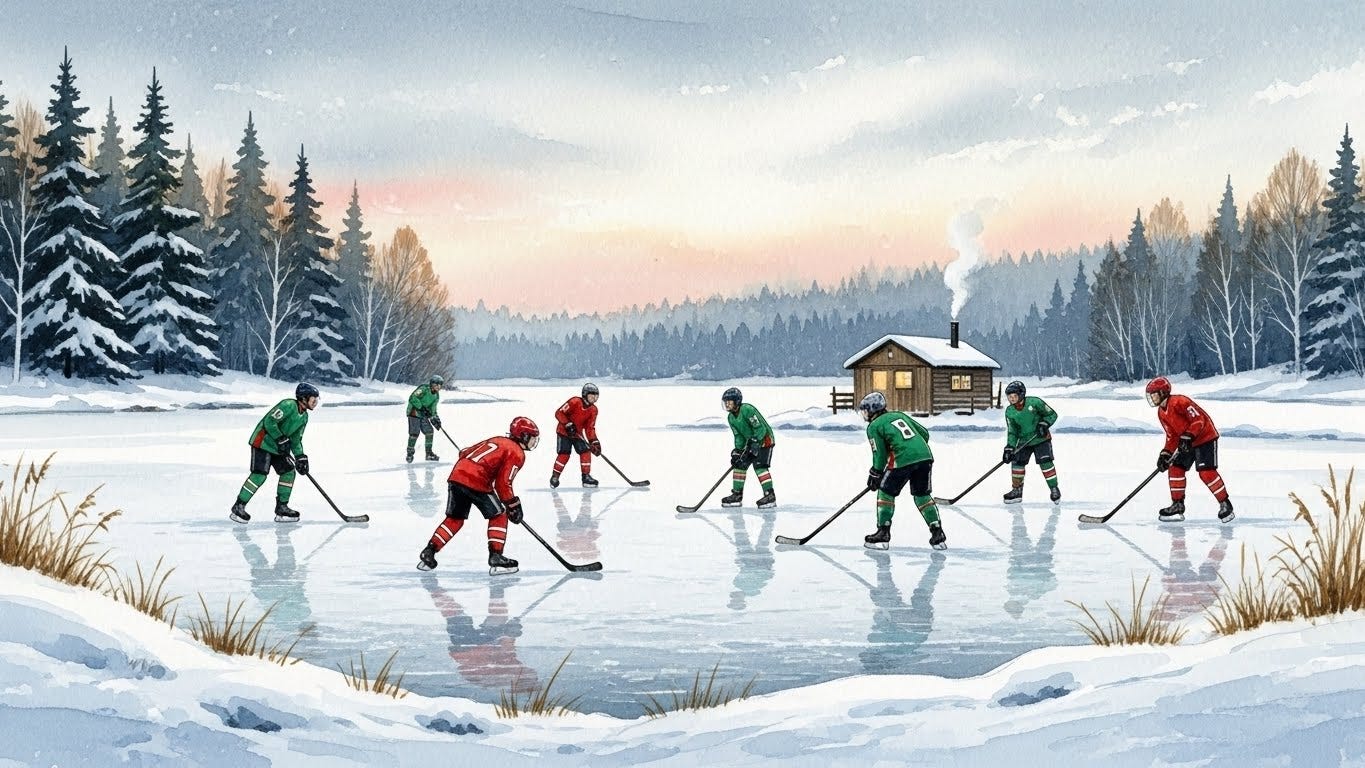
The puck skittered across the ice like a nervous animal, and Anthony Korbin Riendeau chased it with the single minded determination that had made him a decent center, if not a spectacular one. His breath came in white plumes that the wind snatched away immediately, and somewhere behind him he could hear Jamal shouting something that was probably strategic but got lost in the roar of the wind sweeping across the ice.
It was the third afternoon of winter break, and the temperature hovered just cold enough to keep the ice solid but not so cold that fingers went numb inside gloves. Perfect hockey weather, as Anthony’s father would have said, back when he used to say things. The area of lake ice kept cleared by the Northwoods Recreation Collective was especially slick today, perfect for fast breakaways. A small safety and warming shed had also been built right on the shore. It wasn’t fancy, but it was theirs, and during winter break it became the center of their particular universe.
“Anthony! Left! LEFT!”
He pivoted, saw Maya streaking down the left side, her stick held low, and somehow managed to get the puck to her. She took it, deked around Rashid with the kind of grace that made hockey look more like dancing, and fired it past Dmitri’s outstretched glove into the makeshift goal.
“Yes!” Maya pumped her fist in the air, her breath coming hard. “That’s game! Seven-six!”
There were groans from Dmitri’s team and cheers from Anthony’s side, but it was all good natured. They’d been playing pickup games together since primary school, this shifting constellation of secondary schoolers who showed up whenever the ice was good and someone had remembered to bring pucks.
They skated to the boards, collapsing in that satisfied exhaustion that comes after two hours of hard play. Someone, probably Jamal’s older sister Keisha, who was in her last year at Rhinelander Vocational, had brought vacflasks of tea from home, and they passed them around, the warmth seeping through gloves into cold hands.
“You got lucky on that last goal,” Rashid said to Maya, but he was grinning.
“Luck is just skill you’re too proud to acknowledge,” Maya shot back, and everyone laughed.
Anthony checked the time, it was nearly four o’clock. His mother’s shift at the community kitchen started at 1530 and ran until 2000 during the holiday season. If he caught the tram now, he could get there by four-thirty, have an early dinner with her during the lull between lunch service and dinner rush.
“I’m heading out,” he announced, starting to unlace his skates.
“Already?” Jamal looked disappointed. “We were gonna play shinny, just messing around.”
“My mom’s working the holiday shifts,” Anthony explained, pulling on his boots. “Want to catch her while it’s not too busy.”
Understanding rippled through the group. The Yuletide season meant more people traveling, more community events, more demand for services. The principle was fair distribution of labor throughout the year, but reality meant some seasons were a little busier than others.
“Hey you tell Mrs. Riendeau those pierogis were amazing last week,” said Maya. “My babcia said they were almost as good as hers, which is basically the highest compliment possible.”
Anthony grinned. His mother would be pleased to hear that. She took her cooking very seriously. He slung his hockey bag over his shoulder and headed toward the tram stop three blocks away, his skates dangling by their laces. The afternoon sun was already starting its early winter descent, painting the snow covered streets in shades of gold and blue. The Northwoods looked beautiful in winter, he thought. Clean and quiet and purposeful.
The tram arrived within five minutes, the Number 2, which ran from Shepard Lake, through Downtown and then on to the regional airfield. Anthony climbed aboard, tapping his student transit card against the reader. The tram was about half full, workers heading home from day shifts, a few families with shopping bags from stores, and an older gentleman reading a paper copy of The Press.
Anthony found a seat by the window and watched the town slide past. They passed the tool library where his father used to volunteer, back before the accident. Passed the Polyclinic where he’d gotten stitches after taking a puck to the eyebrow last year. Passed the murals that the Arts Collective had painted on the sides of buildings, some bold, bright declarations of labor and community, and hope.
The tram turned onto Thayer Street, and Anthony pulled the cord for his stop. The community kitchen, officially called the Solidarity Community Kitchen No. 7, but everyone just called it “Number Seven”. Originally built in what had been a restaurant in the old days, an entirely new building had been built four years ago. The concept was simple, hearty, affordable food available to everyone. No profit motive, no fancy ambiance, just good meals prepared with care and dignity. Each kitchen had its own character, its own specialties based on the skills of its workers and the preferences of its neighborhood.
Number Seven smelled like heaven. Even from outside, Anthony caught the scent of frying onions, of fresh bread, of the beet soup that his mother made every Wednesday and Friday. He pushed through the door, and warmth enveloped him like an embrace. The dining area was simple but clean with long communal tables made from reclaimed wood, chairs that didn’t match but were comfortable, and walls painted a cheerful yellow that his mother said reminded her of sunflowers. At this hour, between the lunch and dinner rushes, there were maybe a dozen people scattered at the tables. An elderly couple sharing a bowl of soup. A woman in a Transit Authority uniform reading while she ate. A parent with two young children who were more interested in drawing on their paper placemats than eating their vegetables.
Behind the counter, his mother was talking with Yuki, one of the other kitchen workers, gesturing with a wooden spoon as she made some point. She looked a little tired, but her face lit up when she saw Anthony.
“Tone,” she called. “What are you doing here? I thought you’d be playing hockey all day.”
“Finished up early,” Anthony said, dropping his hockey bag by the coat rack. Thought I’d come see you. Maybe eat something that wasn’t whatever Jamal’s sister packed in those vacflasks.”
“It was tea!” came Yuki’s laughing protest from behind the counter. “Perfectly good tea!”
“With honey,” added his mother. “Keisha always remembers the honey. You’re being dramatic.”
Anthony grinned and slid onto one of the stools at the counter. From here, he could see into the kitchen proper, where two other workers, Marcus and grumpy ol’ Peter, were prepping for the dinner rush. Potatoes being peeled, cabbage being shredded, chickens being portioned.
“You hungry?” his mother asked, though she was already moving toward the kitchen. It was a rhetorical question. Anthony was sixteen. He was always hungry.
“What’s good today?”
“Everything is good today,” his mother said with mock indignation. “But the stew is particularly excellent. Marcus made it. Also, we have pierogis, potato, mushroom, or cabbage. Your choice.”
“Mushroom,” Anthony said immediately. “And some of the stew. And is there any bread left?”
“Growing boy,” Yuki said to his mother, shaking her head with exaggerated amazement. “Where does he put it all?”
“Hockey,” his mother replied, already ladling stew into a wide bowl. “He skates it all off.”
She brought him a plate that could have fed two people, pierogi glistening with caramelized onions, a generous portion of stew rich with mushrooms and vegetables, two thick slices of bread, still warm from being heated on the cast iron. She poured him a glass of ponche, the fruit drink that every community kitchen served in the winter, made from whatever fruits were in season or preserved from the previous harvest.
“Sit with me?” Anthony asked as she set the food in front of him.
His mother glanced toward the kitchen, Marcus caught her eye and nodded. “Sit,” he said. “We’re good for now. Dinner rush won’t hit for at least another hour. I’ll just have Peter do anything extra.”
“Like hell,” Peter grunted.
She untied her apron, hung it on the hook, and slid onto the stool next to Anthony. His mother liked her work. She’d always said that feeding people was its own kind of medicine, its own kind of care.
“So,” she said, watching him take his first bite of pierogi. “Did you win?”
“Seven-six,” Anthony said around a mouthful of potato. “Maya got the game winner. You should have seen this deke she did, Rashid didn’t know which way she was going.”
“Maya’s good,” his mother agreed. “Her grandmother comes in here sometimes. Lovely woman. She was telling me about Maya’s application to the Sports Academy in Chicago.”
Anthony nodded. They all knew Maya was probably going to go somewhere bigger after secondary school, somewhere that could really develop her skills. It was exciting and also sad, knowing she might be going and their little team of players would shift and change.
“How’re the Yuletimes so far?” he asked, trying to make it sound casual.
His mother’s expression softened. She knew what he was really asking, Are you okay? Is it too much? Are you taking care of yourself?
“Busy,” she admitted. “But good busy. We’ve been serving more people than usual, lots of families visiting from other regions, workers pulling extra shifts who don’t have time to cook at home. It’s meaningful work, Anthony. I get tired, sure, but I’m not... unhappy.”
She paused, and Anthony knew she was thinking about his father. After the accident three years ago, his father had spent months in rehabilitation, learning to walk again, to use his left hand. He was back at work now, but in a different capacity, quality control instead of assembly line. But something had changed in him. He was quieter now, more distant. Present but not quite there.
“Your father asked about you this morning,” his mother said quietly. “Asked if you were staying warm, if you had proper gloves.”
It was something. It was more than nothing.
“I’m good,” Anthony said. “Gloves are fine.”
They sat in comfortable silence for a moment, Anthony eating, his mother sipping a cup of tea that Yuki had poured for her. Around them, the community kitchen hummed with quiet life. The couple finishing their soup. The Transit Authority worker turning pages. The children finally eating their vegetables after their parent made it into a game.
“The stew’s really good,” Anthony said after a while. “Marcus outdid himself.”
“I’ll tell him you said so. He’ll be insufferable the rest of the week.” But his mother was smiling.
She glanced at the clock on the wall. “You have somewhere to be? Or can you stay a bit longer?”
“Nowhere to be,” Anthony said. “Winter break, remember? Nothing but time.”
“Then help me with something.” His mother stood, moving toward one of the large storage closets. “We’re doing a special menu for Winter Solstice, the longest night dinner. I’m thinking of doing a whole feast, brisket, pierogi, of course, maybe that poppy seed cake my mom used to make. But I want to make sure we’re also repping other cuisines in the neighborhood. Yuki wants to do something Japanese, and Marcus keeps lobbying for his grandmother’s gumbo.”
“Why not all of it?” Anthony asked.
His mother laughed. “Because we’re not miracle workers, Anthony. We’re just cooks with limited time and stove space.”
“But that’s what makes it good, right?” Anthony gestured with his fork. “Like, everyone contributes what they know how to make best. It’s not about making everything, it’s about making the things that matter, together.”
His mother looked at him with an expression he couldn’t quite read. Pride, maybe. Or surprise. Or just the recognition that he was, somehow, despite everything, growing up into someone thoughtful.
“When did you get so wise?” she asked.
“Probably all that time at community kindergarten,” Anthony said, grinning. “They really drilled those collective principles into us.”
“Smart ass,” his mother said, but she was laughing.
She sat back down, and for the next twenty minutes they talked through menu ideas, debating the merits of different dishes, laughing at the memory of the time ol’ Peter had accidentally used salt instead of sugar in a dessert. Other workers drifted over to join the conversation, Yuki with her suggestions, Marcus advocating passionately for his gumbo, even one of the regular customers chiming in with a request for the lentil stew that Number Seven had served last year.
It was, Anthony thought, kind of perfect. This was what the community kitchens were supposed to be, not just places to get food, but places where people gathered, where ideas were exchanged, where the work of feeding people became intertwined with the work of building community. Eventually, the clock showed five-thirty, and the dinner rush began to arrive. Workers from the evening shifts, families who’d been out doing last minute winter shopping, students from the nearby trade school. His mother tied her apron back on, kissed the top of Anthony’s head, and returned to her position behind the counter.
Anthony stayed a bit longer, finishing his meal slowly, watching his mother work. She moved with efficiency from years of practice, plating food, calling orders back to the kitchen, greeting regulars by name, making sure everyone who came through the door felt welcomed and cared for. He understood, watching her, why she liked this work despite the hours. It was the same reason he liked hockey, really. The sense of being part of something larger than yourself. The knowledge that your contribution mattered. The feeling of competence and purpose.
When he finally stood to leave, his mother caught his eye from across the crowded dining room and mouthed “Love you.” He mouthed it back, shouldered his hockey bag, and stepped out into the early evening. The tram ride home took him through the city as it transformed into night, lights coming on in windows, people hurrying home or heading out to evening shifts, the eternal circulation of life. The snow was falling again, soft and steady, and Anthony watched it accumulate on the edge of the tram’s windows.
Tomorrow, if the weather held, they’d play hockey again. Jamal would bring his sister’s vacflasks of tea. Maya would make impossible shots look easy. Rashid would complain about luck while secretly being impressed. And Anthony would chase the puck across the ice with the same determination he’d had today, the same determination he saw in his mother’s work, the same determination that kept the Great Lakes running.
The tram reached his stop, and Anthony stepped off into the snowy evening. Their apartment was three blocks away, in one of the housing cooperatives that lined the edges of the riverwalk. His father would be home by now, probably reading in the living room, maybe listening to the radio broadcast of the nightly news. Anthony walked slowly, in no particular hurry. The hockey bag was heavy on his shoulder, his legs were pleasantly tired from the afternoon’s game, and his stomach was full of his mother’s cooking. Tomorrow was another day of winter break, another day of possibility.
The snow continued to fall on the Northwoods, on the Great Lakes, on all the workers and players and dreamers all trying to build something. And Anthony Korbin Riendeau, sixteen years old, walking home through the winter evening, felt, for this moment at least, that they might succeed.


