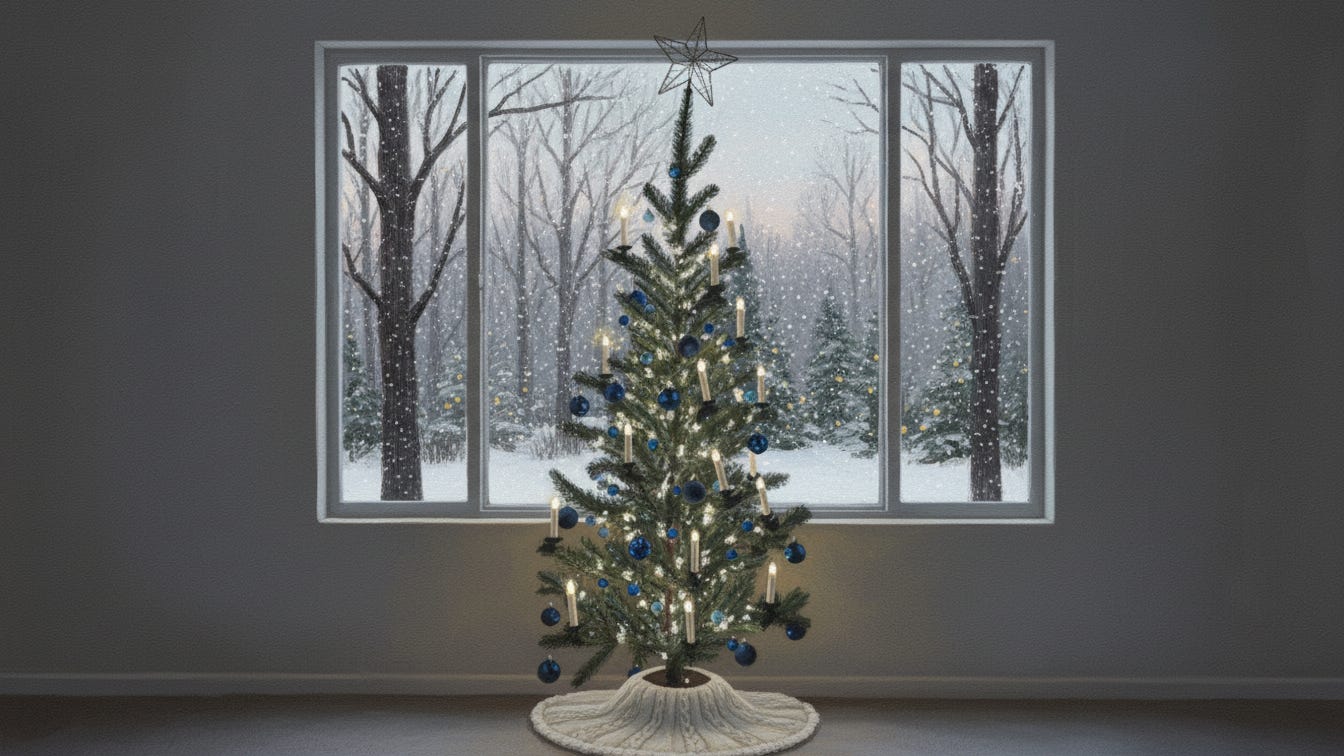
The thing about Christmas trees is that they’re supposed to bring joy, which is why it’s deeply unfair that they also bring a very specific kind of anxiety that makes your right eye twitch while you smile through gritted teeth and tell your children, “Yes, sweetie, that’s a wonderful place for the ornament,” while simultaneously calculating how long you need to wait before you can move it approximately fifteen centimeters to the left where it clearly belongs.
Elena Muller Puley was experiencing this exact phenomenon on a Saturday afternoon in December, standing in the living room of her home, all horizontal lines and honest materials and builtin furniture that she was proud of. The tree stood in front of the band of windows that looked out onto the yard, where snow had settled on everything with the aesthetic precision that nature sometimes achieves when it’s showing off.
The tree itself was modest. Not modest in the way people say “modest” when they mean “enormous but I don’t want to sound braggy.” Actually modest. Maybe one hundred and eighty centimeters tall, slim, elegant in that understated way that suggested it had better things to do than be ostentatious. It was the kind of tree that whispered rather than shouted, the kind that said I am sufficient instead of I am spectacular.
Elena had specifically chosen this tree. She had rejected seven other trees at the cooperative lot before finding this one, which had made the volunteer working the lot visibly concerned for her wellbeing. But she’d known what she wanted, a tree with balanced branches, symmetrical growth patterns, a pleasant conical shape that would require minimal adjustment to achieve visual harmony. What she had not accounted for was that her children, Oscar, who was eight, and Luke, who was six, had absolutely no interest in visual harmony.
“I’m putting the snowman here!” Luke announced, hanging a small wooden snowman ornament on a branch approximately thirty centimeters from where he’d just hung a nearly identical wooden snowman ornament, creating what could only be described as a snowman cluster.
Elena’s eye twitched.
“That’s lovely,” she said, her voice bright with the kind of determined cheer that probably alarmed her children on some subconscious level. “Very creative.”
Oscar, meanwhile, had decided that all the red ornaments should go on the left side of the tree and all the silver ones on the right side, like he was organizing a divorce proceeding for Christmas decorations.
“Oscar, sweetie, maybe we could mix the colors? So it’s more... balanced?”
“I like it this way,” Oskar said, with the absolute certainty of an eight-year-old who has made a decision and will defend it to the death. “It’s organized.”
Elena understood organized. She respected organized. She had color coded the family’s closets. She alphabetized the spices. She had a label maker and was not afraid to use it. But this was not organized. This was segregated. This was Christmas ornament apartheid. She took a deep breath through her nose, held it for four counts, and released it for six. Her therapist had taught her this. Her therapist had also taught her that not everything needed to be perfect, which was a lovely theory but difficult to apply when looking at a Christmas tree that appeared to have been decorated by someone having a stroke.
“Why don’t we take a cookie break?” Elena suggested, because sometimes retreat is the better part of valor.
“YES!” both children shouted simultaneously, abandoning their posts and thundering toward the kitchen with the subtle grace of small elephants.
The moment they were gone, Elena moved.
She was not proud of this. Well, she was a little proud of this, in the way you’re proud of any skill you’ve perfected through years of practice. She could redecorate a Christmas tree in under three minutes while making it look like nothing had changed. She was basically a Christmas ninja.
The snowman cluster was gently redistributed across the front and side branches. The red and silver ornaments were integrated in a pleasing checkerboard pattern. The wooden heart that Luke had hung at knee-height was relocated to eye-level where people could actually see it. The crystal icicle that Oscar had placed directly next to another crystal icicle was moved to provide better visual spacing.
Her hands moved with the efficiency of someone who had been doing this for years. Because she had been doing this for years. Every Christmas, the same dance: children decorate, Elena waits approximately four minutes, children leave for snacks, Elena redecorates, children return and notice nothing because children notice everything except the things you desperately need them to notice.
She stepped back to admire her work. Better. Not perfect, the tree still had that slightly chaotic energy that came from being decorated by humans rather than department store elves, but better. The ornaments were properly distributed by weight, color, and thematic content. The balance was restored. The universe had been returned to order. She could still make adjustments if required as time permitted.
“MOM! Oscar ate my cookie!”
“I did NOT! He’s LYING!”
Elena closed her eyes. The universe had not been returned to order. The universe was never in order. The universe was chaos wearing a nice outfit. She returned to the kitchen, mediated the Great Cookie Incident of this particular Saturday afternoon; resolution: everyone gets another cookie, justice is restored, and herded the children back toward the living room.
“Okay,” she said, injecting enthusiasm into her voice like it was a vaccine against disorder. “Let’s finish decorating!”
Oscar looked at the tree with suspicion. “Did you move stuff?”
Elena’s heart stopped. This was it. This was when her cover was blown. This was when her children realized their mother was a control freak who couldn’t let them do anything without secretly fixing it.
“What? Why would you say that?” Her voice was approximately three octaves higher than normal.
Oscar shrugged. “It looks different, I don’t know, maybe better.”
Elena experienced several emotions simultaneously: relief, guilt, vindication, and a small spark of pride that her eight year old son could recognize superior Christmas tree composition when he saw it.
Luke was already hanging more ornaments, this time a collection of felt reindeer that Elena’s mother had made years ago. Each one was slightly different, ears at different angles, antlers of varying sizes, which made them charming but also made it impossible to hang them with any kind of symmetry because they were each uniquely asymmetrical.
Elena felt her eye twitch again.
“Mom, can I put the star on top?” Oscar asked.
“You put it on last year,” Luke protested immediately. “It’s my turn!”
“You were too short last year!”
“I’m taller now!”
They were going to argue about this for fifteen minutes, Elena knew. They would present cases. They would cite precedent. They would appeal to various principles of fairness and justice. And then Elena would suggest they put it on together, and they would grudgingly agree, and everyone would pretend this was a compromise rather than the only solution that prevented bloodshed.
But first, while they were distracted by their debate, Elena quickly adjusted three of the felt reindeer that Luke had placed in what could only be described as a diagonal line of chaos.
“How about,” Elena said, interrupting the argument before it could reach its full potential, “you both put the star on together?”
Oscar and Luke looked at each other, then at their mother, then at each other again, engaging in the mysterious sibling telepathy.
“Fine,” they said in unison.
Elena retrieved the star from its special box, a simple star painted white, five points, elegant and unpretentious, very appropriate. She lifted Luke while Oscar climbed onto the stepstool, and together, with much discussion and several near drops and one moment where Elena was certain they were all going to die, they placed the star on top of the tree.
It was crooked.
Not slightly crooked. Dramatically crooked. The star was listing at approximately thirty degrees to the left, like it was drunk, like it had given up on life, like it was making a statement about the futility of trying to achieve perfection in an imperfect world.
Elena opened her mouth. Closed it. Opened it again.
“Perfect!” Luke said, clapping his hands.
“Looks good,” Oscar agreed, climbing down from the stepstool.
The star was not perfect. The star looked like it needed medical intervention. The star was a disaster. Elena felt her fingers twitch. She could fix it. It would take two seconds. Just a tiny adjustment, barely noticeable, just enough to restore it to proper vertical alignment.
“Mom, can we turn on the lights?” Luke was already reaching for the plug.
“Wait…” Elena started, but Luke had already plugged them in.
The lights came on. Small white bulbs, evenly spaced along the branches because Elena had personally wrapped them around the tree last night while everyone else was asleep. At least she could control that. At least the lights were perfect.
The lights illuminated the crooked star, the cluster of reindeer, the ornaments that Oscar and Luke had hung with absolutely no regard for color theory or spatial distribution or any of the principles of design that Elena held dear.
It should have looked terrible.
But somehow, and Elena could not explain this, could not reconcile it with her understanding of how aesthetics worked, it looked nice.
Not perfect. Not magazine ready. Not something you’d see in a design blog about Great Lakes Christmas decor. But nice. Warm. Lived in. Like a tree that had been decorated by a family rather than by someone with a mood board and a vision.
“It’s beautiful,” Oskar said quietly, and he meant it.
“The best tree ever,” Luke agreed, and he meant it too.
Elena stood between her children, looking at the tree with its crooked star and its chaotic ornament placement and its complete disregard for symmetry, and felt something in her chest loosen. Not disappear, the part of her brain that wanted to fix everything was eternal and probably genetic, but loosen. Make room for something else.
“Yes,” she said finally. “It’s perfect.”
And then, because she was her mother’s daughter and could only resist temptation for so long, she added, “Although maybe after you go to bed I’ll just straighten the star a tiny bit.”
“Mom!” both children groaned in unison.
“What? It’s crooked!”
“It’s supposed to be crooked,” Oscar said with great patience. “That’s how we put it.”
“It’s got character,” Luke added, which was something Elena had said about a lopsided pottery bowl Luke had made in art class.
Her children were using her words against her. This was karma. This was justice. This was what happened when you tried to teach your children about accepting imperfection while secretly straightening everything they touched.
“Fine,” Elena said, surrendering. “The star stays crooked.”
“Promise?” Oscar demanded.
“I promise.” Elena held up her hand. “I solemnly swear I will not straighten the star.”
She did not promise about the reindeer cluster, or the color segregation that had crept back into the lower branches, or the three ornaments that were clearly too heavy for the branches they were on and would need to be redistributed before they caused structural failure. But she would not touch the star.
Small victories.
They made hot chocolate, the real kind, with actual cocoa and milk and whipped cream, not the packet kind, because Elena had standards even if she was learning to relax them slightly. They sat on the builtin bench beneath the window, looking at their tree, drinking their hot chocolate, and Luke leaned against Elena’s shoulder while Oscar explained in great detail his theory about which reindeer was Rudolph even though none of them had red noses.
Outside, this particular December afternoon was fading into a particular December evening, the sky turning that particular shade of purple gray that happens in winter. Soon Elena’s husband would be home from his shift at the hospital, and they would make dinner together, and the children would argue about something else, and the day would continue in its imperfect, chaotic, beautiful way. But for now, they sat together, looking at their crooked star and their lopsided tree and their imperfectly perfect Christmas decorations.
Elena’s eye still twitched occasionally. Her fingers still itched to make small adjustments. Her brain still cataloged every asymmetry and imbalance. But she sat still, kept her promise, and let the tree be what it was, a tree decorated by children who loved Christmas, loved ornaments, and loved their mother even though she was slightly obsessed with balance.
“Next year,” Luke said sleepily, “can we get a bigger tree?”
“No,” Elena said immediately because she would not succumb to such capitalist excess, and both children laughed because they’d expected exactly that answer.
Some things, after all, were non-negotiable. Some things required standards. Some things needed to be kept small and manageable and proportional to the space they occupied.
But the star could stay crooked.
That was growth.
That was progress.
That was Elena Muller Puley, forty years old, mother of two, owner of a label maker and a very specific vision for how Christmas trees should look, learning, very slowly, very reluctantly, very imperfectly, to let go.
The tree stood in the window, its white lights glowing, its crooked star tilted at thirty degrees, its ornaments distributed with the logic of children rather than the precision of design, and it was, despite everything Elena’s brain told her, exactly right.


