


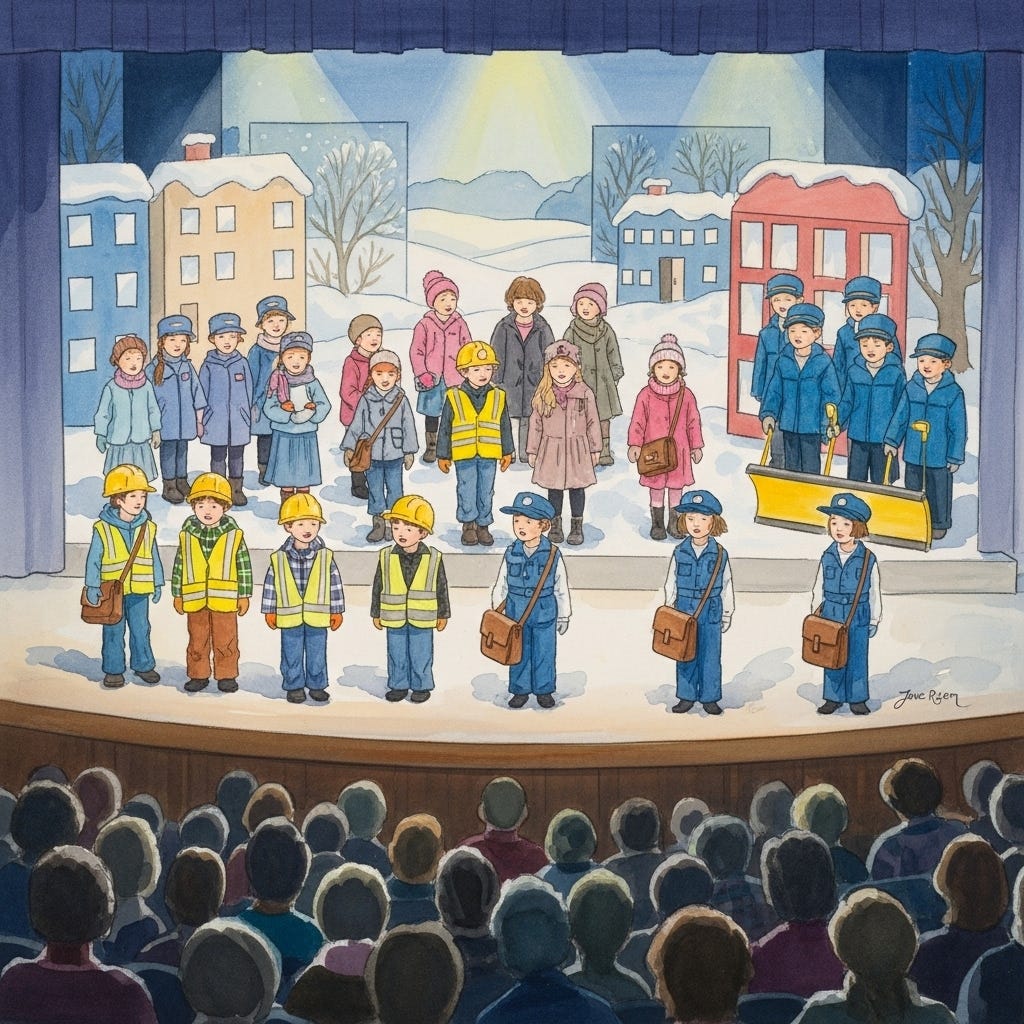
She didn’t understand what had come over her when see had volunteered to work on the student’s winter play. Whatever had possessed her at the end of September was quickly forgotten and it was not until the end of October when her department chair reminded her that practices would start in November that she truly started to think about what she had gotten into. Sure she wouldn’t be the only teacher working on this play, her cohort teacher from across the hall would be helping her.
But even the promise of help quickly faded during the initial practices because it was two teachers against thirty something primary aged students. She and Avery had made a mistake.
“Layla, have you see the construction worker’s hardhats?” Avery called over to her.
“I think I saw them sitting on the steps leading up from the bathrooms for some reason,” Layla craned her neck to see if she could see the hardhats from where she was currently attempting to get a miner’s light to stay fixed to poor little Ricardo’s helmet.
The Greenwood Community School’s small auditorium was starting to fill with people, Layla could hear them from where she was crouched fixing another costume because she has once again, overextended herself. Once it seemed like Ricardo’s light wasn’t going anywhere she stood and made her way over to where she could see the auditorium through a gap in the curtains, she could see the chairs filling up with families. Parents still in their work clothes, the dark green uniforms of the railroads, the blue coveralls of the Water Treatment Collective, some had come straight from their shifts, faces tired but eyes bright with the prospect of seeing their children perform.
It was the last night before the start of the winter break and Layla was ready for winter break. She was ready to sleep in past 0500 and even then just stay in one of her cozy chunky knit sweaters and enjoy the blissful separation of personal belief and public institutions for the next three weeks.
But now, three months after her misguided decision to volunteer, the children were costumed in the tools of a thousand trades. Elena wore the forest-green vest of a park ranger, her seven-year-old face serious beneath a ranger’s campaign hat borrowed from her uncle. Marcus had transformed into a garbage collector, complete with the orange safety vest and gloves he’d insisted on getting exactly right. Little Aisha, the smallest child in first grade, wore a white coat several sizes too large, a toy stethoscope around her neck, already practicing the grave expression she thought doctors must wear.
“Five minutes,” Avery said to Layla before turning back to the children. “Miners to stage left, construction workers to stage right. Fishermen, where are my fishermen?”
“Here!” called three children in yellow rain slickers and rubber boots, waving enthusiastically. Layla had made sure there was a least one girl fisherman, fisherwoman.
She did one final check of her own students. There was Dmitri in his custodian’s uniform, pushing a child-sized mop with real pride. Maya dressed as a teacher, Layla’s old glasses perched on her nose, prescription lenses popped out, a stack of picture books in her arms. And Kenji, silent Kenji who rarely spoke in class, wearing the blue shirt and badge of the Railway Workers’ Union, his grandfather’s actual cap from his thirty years as an engineer resting on his head like a crown.
The lights dimmed. The audience settled. Principal Okafor stepped to the microphone, her voice warm and carrying.
“Neighbors, comrades, friends. Tonight our children present to you ‘The Winter Workers’ Pageant: A Celebration of Labor and Community in the Great Lakes Democratic Republic.’”
The curtain, really just some bedsheets sewn together, pulled back.
The stage was simple. They’d painted a backdrop showing the Republic’s geography the vast expanse of the Great Lakes, the forests of pine and birch, the cities with their distinctive architecture, the farmland stretching toward horizons. It was Ms. Rodriguez Makeba’s fourth-year class who’d painted it, working after school for two weeks, arguing passionately about how much larger Chicago should be from say, Detroit; they’d compromised by making them the same size, which actually made Layla laugh, thinking it was probably good practice for their future in democratic governance.
The miners entered first, their helmets sporting real battery-powered lights, Ricardo’s thankfully still secured. They moved in formation across the stage, and young Sofia stepped forward.
“We go into mother earth,” she said clearly, her voice barely shaking, “to bring up what the Republic needs. Iron for the foundries. Copper for the wires. Salt for the winter roads. We work together in the depths, and we keep each other safe.”
The audience applauded, and Layla saw Sofia’s mother in the third row wiping her eyes. Next came the construction workers, six students who demonstrated, in carefully choreographed pantomime, a close approximation of the the building of a structure each one an important participant, the surveyor, the excavator operator, the carpenter, the electrician, the mason, the inspector.
“We build homes,” Tomás announced. “And schools. And libraries. And hospitals. We build the places where the Republic lives.”
The pageant continued, each group of workers taking their turn. The fishermen cast their nets in graceful arcs, talking about sustainable harvest and aquaculture. The park rangers spoke of protecting the wilderness and teaching children about the forests. The agricultural workers, covered in construction paper vegetables pinned to their overalls, talked about the seasonal cycle of planting and harvest, how they fed the Republic.
Then came Maya, stepping forward in her teacher costume, Layla’s glasses sliding down her nose.
“We are teachers,” she said, gesturing to include Miriam and two others who’d also chosen this profession. “We help children learn to read and think and question and understand. We teach history so we remember where we came from. We teach science so we understand how things work. We teach math so we can build and measure and distribute fairly. We teach because every child deserves to know they are capable of learning.”
And Layla felt a lump in her throat. Those weren’t the exact words they’d practiced. Maya had made them her own.
The doctors and nurses came next, speaking of caring for the sick and preventing illness. The garbage collectors talked about waste management and recycling, about keeping the cities clean and healthy. The railway workers, led by Kenji, who had found his voice, described the vast network of trains that connected the Republic, carrying people and goods and ideas from one place to another.
“My grandfather,” Kenji said, diverging from the script, “says the railway is like the Republic’s bloodstream. It keeps everything connected and alive.”
More workers followed: the childcare providers, the librarians, the Posti workers, the engineers who maintained the water systems, the electricians who kept the power flowing, the cooks in the collective kitchens, the textile workers, the researchers, the artists, yes, even the artists, which had been a point of debate but Layla had firmly stated that beauty and culture were also labor, also necessary, also dignified.
Finally, all the children gathered on stage together, a mass of different uniforms and tools and purposes. Young Dmitri stepped forward with his mop, looking very serious.
“Every job is important,” he said. “Every worker is necessary. When we all work together, the Republic works.”
And then they sang the song that Avery had been teaching them, something with lyrics that were simple enough for primary school students but meaningful enough that the adults in the audience were singing along by the second verse:
From the mines to the fields to the great lakeshore
From the forests to the cities and everything more
Every hand that labors, every mind that thinks
Every heart that cares is what binds our links
No worker stands alone, no task too small
When we work together, we provide for all
The final note hung in the air of the little auditorium, and for a moment there was silence. Then the applause came, parents and grandparents and siblings on their feet, clapping and cheering.
Layla watched the children take their bows, with little giggles and waves to their families. Afterward, as families mingled in the auditorium annex, someone had brought cookies and a punch that was a winter tradition. Children ran between legs, still in their costumes, trading hard hats and stethoscopes and ranger badges, trying on each other’s futures. Layla looked around at the families gathering their children, at the laughter and the tired contentment that comes at the end of a semester, at the beginning of winter break when rest is not just permitted but encouraged.
Outside, the real snow of winter had begun to fall, soft and steady over Detroit, or maybe it was Chicago, or Thunder Bay, or any of the cities of the Great Lakes Democratic Republic where the lights were coming on in windows, where workers were coming home, where children in makeshift costumes were explaining to their parents the important jobs they’d portrayed, where the winter break stretched ahead like a promise that rest and labor, community and individual, could exist in balance.
The families began to leave, carrying their children and their winter coats, stepping out into the cold night that felt, somehow, a little warmer than it had before. Layla turned off the auditorium lights, leaving only the green glow of the exit signs. In three weeks, the children would return, and there would be lessons to teach and skills to learn and futures to prepare for. But tonight, Layla really felt it, they had celebrated something essential, that every person’s labor mattered, that the Republic was built by all of them together, that the winter could be faced with dignity and community and hope.
She locked the door behind her and walked out into the snow, thinking that she would probably volunteer for next year’s pageant, yes, she was already forming ideas in her mind. But that was for later. Tonight she would go home and rest, for the pause between one season’s labor and the next. The snow fell on the Great Lakes Democratic Republic, on all the workers sleeping and waking, resting and laboring, separate and together, individual and collective, human and necessary.
And the children dreamed of the work they would do, the lives they would build, the Republic they would maintain and reimagine and pass on to the next generation of miners and teachers and fishermen and builders and dreamers, and the snow continued to fall, soft and steady, covering everything in white.